| 29 October 2014 |

|
|
| BBC Homepage | | |
| |||
| Contact Us | | |
Theatre and Dance PreviewsYou are in: Beds Herts and Bucks > Entertainment > Theatre and Art > Theatre and Dance Previews > An English success story! 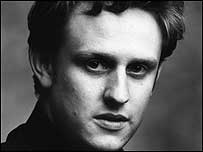 Richard Goulding An English success story!Katy Lewis He's starring in An English Tragedy at the Watford Palace, but Richard Goulding's story is more a tale of success! An English TragedyWatford Palace Theatre WORLD PREMIERE An English Tragedy by Ronald Harwood 14 February – 8 March 2008 Director: Di Trevis A world premiere of a play by the Oscar-Winning playwright Ronald Harwood is launching the Watford Palace's centenary season this month. An English Tragedy is a powerful, gripping tale of conflicting loyalties and wartime treason, based on the true story of the British fascist John Amery, a complex and fascinating man, who was arrested and charged with high treason in 1945 after making propaganda broadcasts for Nazi Germany. The trial was made more sensational by the fact he was the son of Leo Amery who served in Winston Churchill’s cabinet during the war. Taking on the lead role is young actor Richard Goulding who has just finished a stint with the RSC playing Konstantin in Trevor Nunn’s The Seagull and also took on parts in Nunn's King Lear, which starred Sir Ian McKellen in the title role. Richard graduated early from the Guildhall School of Music and Drama to be in these productions which were seen in the West End, Stratford and around the world - a dream first job by anyone's standards! He told us all about his latest role and how he came to be plucked from obscurity to be on stage with some of the UK's finest actors! Can you tell us the premise of An English Tragedy because it's a true story isn't it?Richard: Yes - it's about a young man called John Amery who was the son of a British Cabinet Minister, who was the Secretary of State for India and Burma during the Second World War. 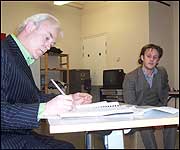 An English Tragedy in rehearsal He [John] was quite a character. He fell into a lot of debt and enjoyed money, fast cars and women and ended up bankrupt in Europe during the war. He fell in with a lot of people with fascist sentiments and in the end was employed by the Nazis in Berlin to broadcast to Britain, encouraging the British government and the British people to side with German against Russia, which in the minds of the Nazis meant Jews and Communists essentially, which in their warped sense of things were the same thing. So, essentially he was guilty of treason by inciting British people to rise up against the British government which at that time was fighting against the Germans. That's essentially what he did, but there are much more complicated things within that. There is a rather exciting and interesting twist in the plot to do with his identity and his family and the play is not only about what he did, it's actually more about the family and the impact which that sort of behaviour has on a family, and a father who, being involved in politics, had high hopes for his eldest son. But those hopes are dashed fairly dramatically by this reckless behaviour. You play John Amery, what would you say he is like?Richard: That's a very tricky question! As an actor one mustn't judge one's character in anyway, you've simply got to inhabit it and try to justify his beliefs and his actions so I must try not to be too judgemental! But I think it's fair to say that these days he would be diagnosed with some sort of behavioural disorder. At the time of the trial he was examined by psychiatrists because obviously his parents were trying as best as they could to find a reason for him not to be tried or at least not to be found guilty. One of the avenues they went down was this mental instability that he clearly had. He behaved outrageously, even as a child. When his younger brother was born it was recorded that when told that he had a younger brother he said, "That's jolly nice but I think I'd have preferred a cat!" So his reactions were rather swift, instinctive and impulsive. He was very witty and very charming but it was said he had no concept of moral right or wrong and coupled with that he was unable to connect actions that had happened to their consequences. So, with anything that he did, he would have no idea it was said, what it would lead to, or its effect on other people. I think probably he had no sense of empathy or sympathy. He was a very charming guy who unfortunately fell in with the wrong people, but I think that these days he would have been protected by some sort of diagnosis. It's interesting that if it's a bit different from normal, it's called a condition. It could just be how he was?Richard: Yes - the psychiatrist who examined him said he knew what he was doing, he knew it was against the law, but he was consciously doing it because it was what he believed in. It was a passionately held political belief and his actions were done ironically, not because he wanted to be treacherous, but because he was a deep heartfelt patriot so he believed completely that what he was doing was right - it just so happened that it wasn't. But yes, it's odd that these days you can say that a person is like this because of a condition and often it can just simply be bad behaviour. But I think in his case the psychiatrist's reports definitely identified what they called moral imbecility which means he had no concept of a moral ethic. It sounds like you've done a lot of research, is that how you normally approach your parts?Richard: Luckily this is a true story so there is documented evidence. His father was a habitual diary writer so there's a lot of his view of it and it's also a fairly well-documented case because it was a treason trial after the Second World War and there was a lot of public interest in it. There are lots of books and documents you can read and all the characters in the play actually existed so Wikipedia is wonderful! But on the other hand, while the research is useful, in the end what you've got to respond to is the situation in the play and that's what matters, that's what the audience sees. We don't go on stage to regurgitate a load of research. But it's useful to keep it in the back of the mind. So what's in the play - is it one specific incident or does it tell the whole story?Richard: It starts just after the war when he was captured in Italy with Mussolini by Italian Communists. It starts with an interrogation and the play takes place over the course of one year up to and including his trial. And of course, during the dialogues and the scenes there is a discussion of what happened before in his life so you get a picture of that. It's a fairly dramatic time. Ronald Harwood clearly wants to explore the relationship between Jack and his father, mother and brother. That relationship is very central because it's the investigation of the pressure cooker that a treason trial is. One's life is at stake, so hopefully this crunch moment will be very intense and very moving. Without giving too much away the relationship between his father and him is entirely central because in a sense his actions are based on a desperate and vile hatred of his father - but for reasons that I can't possibly disclose because that would explain the play! And it's a world premiere?Richard: It is, we're very lucky and it's the most fantastic play. I read it and thought it was the best thing I'd read for years - really wonderful. And you're creating a role, even though it's a true story?Richard: Yes. When doing a historical figure you are creating it for yourself and the audience for this production, but it's very, very different from doing a well established role in a famous play because there are so many people who have gone before. And of course you're used to doing well-established roles in famous plays?!Richard: [laughs] I'm not really used to it but I have just come from a job where that was the case. We were doing two plays which have been done countless times I should think! Yes - you've just been in the West End and Stratford playing Konstantin in The Seagull directed by Trevor Nunn and were also in his King Lear starring Ian McKellen in the title role? How did you get into those productions because you were still at college weren't you?Richard: Yes - I was phenomenally lucky! Essentially, I completed the first term of my third year of my drama training at the Guildhall School of Music and Drama. We were doing a production of The Tempest and I was lucky enough to be cast as Prospero in that. Then, that production became part of the RSC's Complete Works series in Stratford in a very minor capacity - we were doing a tour of schools in Stratford. The casting director of the RSC was obviously scouting for young actors and came to see it and saw me. Then, Sam Jones the head of casting up there, gave me a call two months later and asked me to come and audition for the show to play Konstantin. I thought it was a joke, I thought somebody was winding me up! I'd come out of the Swan Theatre in Stratford having done The Tempest there and I saw a promotional poster there for King Lear and The Seagull starring Ian McKellen and directed by Trevor Nunn for an RSC world tour. I thought that would be quite a job to get and four months later I was in it! It was unbelievable. Those two plays I happened to have done at school and seen a lot so they were very close to my heart and to have been involved in them as a first job was literally a dream come true but I couldn't have dreamt it actually! It must be a dream job to be in something with Sir Ian. When you're in a production like that with somebody so experienced, what is their attitude towards the younger actors. Was he helpful?Richard: Oh tremendously. I was terrified, absolutely quaking with fear on the first day. It was a big company of 23, with McKellen obviously at the top of it, and there were lots of other well-known faces and names in the company and I was the new kid. I wasn't the only one but I was the only one who had been cast in such an exposing role. But they were delightful, it was wonderful to find that these incredibly experienced and knowledgeable actors wanted to pass on their expertise. As is said at the end of The History Boys "Pass it on lads" - there's a tradition that needs to be passed on. It was a joy to find out that their enthusiasm had not been dimmed by experience and they were incredibly helpful. But they also knew when to back off, and when to let younger actors create for themselves. He [Sir Ian] was absolutely delightful and of course it was a privilege for me. In King Lear I was at the back doing bits and bobs like messengers and things which are much more what one would expect a first job to be, and it was a real privilege to watch him doing his King Lear for a year from the back of the stage. And the wonderful thing about him and other experienced actors in the company is that they weren't ashamed or afraid to make mistakes which is an incredibly valuable thing to learn. The ability to let something go (to cancel and continue is the phrase we use) and to simply just go on creating and imagining in the moment on the stage is thrilling to watch and thrilling to be a part of. So really you didn't need that last year of drama school?!Richard: [laughs] Well drama school is two things really. On a purely practical and professional level it's a preparation to be employed in the industry, to get jobs, to know how to work and in that sense my training fulfilled that for me because luckily I went straight into a job. The other thing is that it's a wonderful experience and three years is rather too short, it should go on for ten really, all your life! Every play you do is an education. Having to learn on the job, you are just forced into situations where you have to make decisions and you have to do it. That's what's different about drama school and the professional environment. In a professional rehearsal you just have to come up with the goods, in drama school there's a nurturing that goes on, a care for you as a person and that doesn't exist so much in the professional world, you just have to take care of yourself and be incredibly strong and thick skinned - that's something I've really learned over the past year! But I did miss out on the second half of my third year at drama school. It wasn't a difficult decision to go and work for the RSC but on the other hand I would have loved to have finished. I went back to see the final production of a musical that my year were in and that was really rather moving and I felt a little bit estranged from it and that was a shame. There were only 24 people in my year and it's a little fraternity, a club, a family almost. You do get very close to each other and once that breaks it's quite a shift in your life really. Your career has had a flying start and begun with something that you might have had an ambition to do at the start so what's your ambition now?!Richard: I've got plenty of ambitions! I always said I wanted to work for the RSC early in my career and I've done that but I'm not ticking boxes - as an actor one has to take what comes along really. I'm lucky I suppose, that having had this job and had the exposure that I've had around the world, people will have seen it and they may remember it, so the chances are greater that jobs will come along. I don't really know, but I have plenty of ambitions. In my loftier moments I want to play all the classics, do all the great Shakespearian roles, but there are hundreds of things. I haven't ever done any film or TV so that would be wonderful to get into and learn about and of course it's wonderful to do a new play like this! last updated: 14/02/2008 at 12:10 You are in: Beds Herts and Bucks > Entertainment > Theatre and Art > Theatre and Dance Previews > An English success story!  Rhythms of the World! |
| | About the BBC | Help | Terms of Use | Privacy & Cookies Policy |