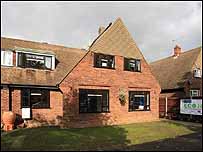
A traditional 1950s semi has been transformed into an energy efficient home by St Albans City and District Council in what is believed to be one of the first projects of its kind. The council house is literally packed with energy and water saving features including a solar panel, a wind turbine and a 4,700-litre underground rainwater-recycling tank.
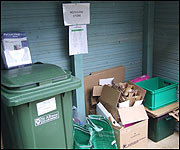 | | The recycling unit |
Paola Munns, Asset Manager at St Albans District Council, explained the idea behind the project. "We've been doing cavity wall, loft insulation works and double glazing for a long time on our stock" she said. "We're looking at moving up a step and looking at alternative technologies and what else we can do to make our homes more energy efficient, and also to use less energy, because as you can appreciate, our residents don't have that much disposable income." Monitoring All the energy-efficient features have monitoring equipment attached that beams the results direct to the Council’s offices and their effectiveness will be assessed to help the Council to decide which elements should be installed in other Council houses. "All the energy that comes in from the utilities, all the energy that's produced by the wind turbine, the solar thermal panels, and the rainwater recycling unit and all the energy that the family consumes is being monitored by pulse metres" explained Paola.
 | | Wind turbine |
"These radio transmit to a data logger in the house which sends the information back to my computer in the office so I can remotely monitor everything that goes on here on a daily basis. "That's the exciting bit for me" she continued. "The manufacturers make a lot of claims about all of the stuff we've done here but there's nothing quite like having hard fast facts. We've said this is what we've done in the house, and this is what we anticipate but it would be wonderful if what we anticipate actually happens." Energy saving The house in Smallford was modified by local building contractor Borras and is packed with energy saving ideas that all of us could adopt to reduce our impact on the environment with little if any effect on our daily lives. The results of the monitoring, which will take place over a year, will be made public so that anybody thinking of incorporating the features into their own homes will be able to benefit from the Council's experiences. "We're going to monitor it for a year because I think you have to go through the four seasonal cycles" revealed Paola.
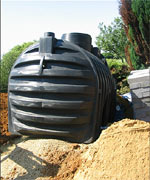 | | 4,700-litre rainwater-recycling tank |
"We've said all along that we will be making this data available to anyone and everyone. The number of people I've had round here so far are obviously very keen on using these technologies but sometimes it's better to have a bit more information, so if you can hang on a while, see what our experiences are and learn from those." Cllr Aislinn Lee, the council’s portfolio holder for housing, said: "One of the many exciting aspects of this project is that we believe we are one of the first councils to take such a bold initiative to address the issue of greening existing stock. “The eco features installed in this house, and the monitoring we are going to undertake, will help us to understand exactly how much benefit - in environmental and financial terms - we can expect from each element. Beyond that, we hope that many people will be inspired by our eco house to look at ways to reduce their energy and water use." So - what's it got?! Solar roof panel Provides some of the hot water for the house, possibly all in summer, reducing use of gas. 1,000 watt wind turbine Expected to generate enough power to run equipment that is always on, such as the fridge and freezer, and items accidentally left on standby, reducing use of mains electricity 4,700-litre rainwater-recycling tank (underground) The water will be used for the washing machine and for flushing toilets, reducing use of mains drinking water. Extension Timber framed and clad in Western Cedar from Canadian forests, which requires less energy to produce than conventional brickwork “Living” sedum roof Planted with sedum, this roof is designed to insulate the structure naturally, and reduce rainwater run-off by absorption. Argon-filled timber framed double glazing The glass is specially coated to help it retain heat and the argon acts as a further barrier to reduce heat loss. The frames are wooden rather than plastic. Sun pipes Bringing natural daylight into the darker areas of the house, in particular the landing, to reduce use of electric lighting Small photovoltaic panel Powers bathroom extractor fan by converting sunlight into electricity Vents Passive-stack ventilation - uses fact that heat rises to remove damp air from the house without using electrical extractors Garden Drought-resistant planting in front garden Recycling A dedicated area has been built to house recycling boxes Parking The plastic ‘grasscrete’ was saved from disposal from another project that the contractors Borras were working on, and recycled to create a parking area to the front of the property. What can’t I see? Highly efficient condensing boiler to run the central heating system
Water-saving taps
Half-flush toilets
Roof insulation made with recycled newspaper, wool and hemp.
Rainwater and gre water collection for watering garden plants
Use of energy-efficient white goods ie washing machine and dishwasher Considerate constructor Demolition materials, including rubble and old plastic windows, have been re-used or recycled - helping the contractor Borras earn a Considerate Constructor certificate for the way it has handled site operations. |