| Edward Scissorhands | Milton Keynes Theatre
9-13 May 2006 Edward Scissorhands Dance Workshop Thursday 11 May at Milton Keynes Theatre 3.30-5.30pm Matthew Bourne's company of dancers will take you through the repertoire. The class is aimed for those aged 14+ who already have dance experience. |
Buckinghamshire audiences have enjoyed a number of productions from Matthew Bourne and his exciting New Adventures company recently. "The Nutcracker", "Play Without Words", "Highland Fling" and of course the renowned "Swan Lake" with the male swans have all visited either the Milton Keynes Theatre or the Swan Theatre in High Wycombe. And now the man who is probably Britain's most popular choreographer is returning with a brand new production, on tour in the UK after a successful Christmas season at Sadlers Wells. Their exciting new adaptation of the classic Tim Burton film Edward Scissorhands can be seen in High Wycombe from 25-29 April and in Milton Keynes from 9-13 May. This touching and witty gothic fairytale, which confirmed Burton as one of the most imaginative filmmakers of our time, tells the story of a boy created by an eccentric inventor who dies leaving him alone and unfinished. Left with only scissors for hands, Edward must find his place in a strange new suburban world where the well-meaning community struggle to see past his strange appearance to the innocence and gentleness within. Matthew Bourne both directs and choreographs this new production with design by long-term collaborator Lez Brotherston. Original music has been composed by Terry Davies with adaptations of musical themes from the motion picture composed by Danny Elfman [The Simpsons, Desperate Housewives]. A boy who can't touch, and who has unweildy attachments on the ends of his hands, may sound like a very unusual subject to get the dance treatment. But if anyone can do it Bourne can, and as he told us, the themes within it make it ideal. It's quite well documented that you're a lover of film but it's taken you quite a while to do a film adaptation in dance. Were you just waiting for the right piece? Matthew: I've never thought about it that way really because most of the pieces I've done have had some sort of film influence in them. Sometimes there’s one main film, sometimes several films or bits of the piece remind you of a certain film or whatever. The “Car Man” was based heavily on the film “The Postman Always Rings Twice” and “Play Without Words” was based quite heavily on a film called “The Servant” but this is the first time where it truly is based on something that is only a film really. It's not a story that exists in any other form.
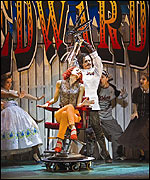 | | Edward Scissorhands: Michela Meazza and Sam Archer |
Edward Scissorhands is the first time we've actually properly adapted a film as a dance piece. I don't know why it's taken so long but it just felt like it was such a unique piece with a unique title that I didn't want to change it that much and turn it into something else. So what attracted you to transforming this particular film into a dance piece? Matthew: Well, I thought that Edward himself was quite a silent character and most of what he did [in the film] was shown through movement in some way. He doesn't say much in the film. He's almost like a Buster Keaton or Charlie Chaplin sort of figure so that attracted me quite a bit. I love the fact that he's an outsider and the thing that's different about him, i.e. his hands, can sort of represent anything that's different about anyone. It can be the smallest to the biggest thing. It can be a disability of some kind, it could be a racial thing, it could be just the kid at school who looks a bit different to everyone else. I felt that this was a really nice universal theme that would touch a lot of people. The outsider? Matthew: Yes. I think that also in the film, the thing that drew me in heavily when I first saw it was Danny Elfman's music because I thought it was such a wonderful score. I thought that the music was theatrical and that it could have a theatrical life. I thought you could dance to it, I thought it would sound wonderful in the theatre and it was one of the things that made the film more emotional I think. The score is much more grandly melodic than you would normally get in that kind of film so that was another reason why I was drawn to it. And there was also the mixture of the worlds, the Gothic world and the suburban world. It was fun and there were lots of chances for comedy and social observation. And it's got a great unusual sort of love story in the middle of it and it's also very moving as well. I like to mix those things. Edward can't really touch though can he, which is kind of an interesting concept for a dance piece? Matthew: Yes it is. He does manage to do duets and things with the hands but of course you're limited naturally by the character and by the hands themselves. But giving yourself a limitation like that is always good for choreography, it always makes you think of new things which means you have to sort of solve it. It's also much easier than just being able to do anything you want which is always awful. You know the kind of thing, man and woman now do love duet! It's just too wide an idea. The hands do present problems but they are also what the piece is about in many ways and they've given us lots of lovely ideas as well. Have you had any problems rehearsing with them, any accidents? Matthew: No major accidents no, but people get hit by them occasionally. If you imagine another foot and a bit on the end of your fingertips when you've got your arms outspread, you do take up a lot of space on stage. So with a stage full of people, another 20 maybe, you really have to watch where you're going and people have to keep out of the way. If he [Edward] is dancing it takes up a big space so there have been a few little nips here and there but they're less dangerous than they look really!
The girls did wear goggles, like swimming goggles, for the first few rehearsals in the duets just to make sure they didn't get hurt. But it actually ended up being worse because they couldn't really see what they were doing either! So, this show is full of problems in many ways!
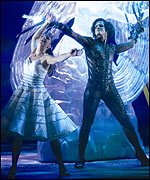 | | Edward Scissorhands: Kerry Biggin and Sam Archer |
They are used to them [the scissors] now though but they can still break quite easily and they're an ongoing job in the show. There's a guy whose specific job it is to look after the hands. Every time Edward comes off he checks quickly in the wings that they're OK because they [the dancers who play Edward] can't do anything for themselves once they're on. They're very limited in what they can do, they can't adjust anything in their costume. If they get a hair in their eye it's very difficult to do anything about it so they're a bit helpless, which kind of helps their character, but they are genuinely helpless as well once they're in that costume. What about going to the toilet? Matthew: They can't! That's it for the whole show and it takes them about an hour to get ready and quite a while to get out of it as well. They're not exactly sewn into their costume, but they're laced into it, so it's very difficult to get out of it quickly. Getting back to the concept then, you've got the original music with additional contributions and you've got some of the original team on board, so how did you actually approach turning the film into a dance piece? Matthew: I approached it as a piece of theatre. I’ll start by thinking, this is the story, and these are the important aspects of the story. Now, we've got to turn it into a piece which is firstly theatrically exciting and secondly is dance and movement. I'll look for opportunities to dance and tell stories through movement so some of the things in the film were naturally rejected because they didn't seem appropriate for the stage or for movement and others developed because they were. You find ways of achieving the same feelings and the same ideas but in a different way so it's very different from the film actually. I worked alongside Caroline Thompson who wrote the story originally in the screenplay – and we passed the scenario backwards and forwards to each other for several years actually! It's now developed into a piece of theatre. It's got a prologue which isn't in the film which explains how Edward was made in the first place, how he was created. And the ending is very different from the film. There are lots of scenes in the show that aren't in the film and lots of scenes in the film that aren't in the show. If you saw the film several years ago you'd probably watch it and think that it’s just like the film, but actually if you watched it last night and then saw the show today you'd see big differences. But the essential theme is there? Matthew: Oh yes, and the character and, I've realised through doing it, that people love the character. Particularly young people, he's very popular with the teenage audience, they identify with him. You had Tim Burton's blessing for this project - has he seen it? Matthew: Yes - he came to the first night at Sadlers Wells. He hadn't seen it in any rehearsals or anything and he really enjoyed it, and his partner Helena Bonham Carter absolutely loved it. I thought he was an absolute gent when he came to see it. He was there to really help the show and he did all the interviews and photos and I don’t think that’s something he naturally enjoys. But he was such a lovely guy that night, just as he was when he gave permission for us to do it because he was very generous. It was such a personal project for him and I think to pass that onto someone else was quite a big thing for him. But I also think he felt that it was so different from what he does. Firstly it was on stage and also it was once removed again by being a dance piece, so I think he just felt it was a different world, and something that needed someone else to take it on board and do it in their way so he just handed it over and was very generous about it. What do you feel has been the biggest challenge? Matthew: The biggest challenge is often people's expectations and you have to walk this tightrope between pleasing people who love the film, pleasing people who've never heard about the film, telling a story well and making it work for both those sets of people. I think that's one of the biggest challenges, to please people who think how could you possibly make this film any better by putting it on stage? Then there's the audience who say “I don't know it, I've never seen it” so you've got to tell the story very clearly.
The other challenges are mainly to do with the fact that the stage is full of different characters. We try and represent the whole of this town that Edward arrives in so each dancer is individually characterised with costume and character. It's based on six families who have all got different identities as families and as individuals so the other challenge is to unify that in some way as well as it can be quite difficult to have that many characters on stage at any one time. There are bits in the show where there's quite a lot to look at but I do think that when it's important we focus it and it's what you need to be looking at. So that was another challenge really - the individuality and the wider picture. Would you accept that you're the most successful British choreographer? Matthew: I accept that I'm probably the most popular British choreographer at the moment and I say that purely in terms of people coming to the shows. And I can say it as a matter of FACT in a way because of the amount of audience that we have. Our shows do play to many more people who don't go to dance, so in that sense yes. I wouldn't say I was the BEST choreographer in Britain but probably the most popular - yes I would accept that! [laughs] Do you have a production you’re most proud of or is it always one you're working on? Matthew: Umm - I'm proud of all the pieces that I've done really because I put so much into them that I do still really like them when I see them again. That doesn't mean to say I'm not critical of them and want to make them better. I always want to make them better and I’m always looking for new things. The company has that mind set, they're not like a normal dance company everyone’s still searching and looking for things. The thing I'm most proud of is not particularly one show, it's just the growth of the audience and the fact that people will come and see the show again and again and want to come to the next show. There’s the fact that all the tours have gone very well, people will come back and they'll bring their friends I'm very proud of that. I think that the growth in the audience is something that really excites me. That also symbolises the change in attitudes that people have had towards dance. People come and see your shows that maybe haven't been to a dance show before. I've taken people to "Swan Lake" who wouldn't have seen the tutus and tights version but who have come away from that thinking “wow”!
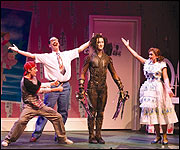 | | Edward Scissorhands |
Matthew: That's the thing I feel proudest of in a way, that that has genuinely happened. After seeing your Swan Lake I wondered how on earth anyone could have thought that the swans could be women? Matthew: [laughs] That's one of the funny things that's happened over the last ten years. When we first did it, it was like “how can you do this, how can you take this on?” Everyone was very wary of it. And now ten years on it's studied in schools all over the country. It's part of the text that people have to study to do A’ Level and GCSE and for many of those younger people who have seen it, that's the only Swan Lake they have seen. They don't know the other one and they’re saying they can't imagine it with women. It was seen to be rather avant garde and alternative when it was premiered and now it's there in the history books which is amazing. What's next for you then? Matthew: There might be a TV thing. The BBC is keen to do a new dance piece for television which is very, very rare. We've had pieces filmed before but they've been made for the stage. This is an idea where it would be created for television which I think is a great idea. It very rarely happens because it's so expensive because you have to rehearse it, and rehearsal costs can be enormous. So that's something I shouldn't pass up on. I don't really know what my next stage show will be, it's too early to say yet. I'm going to try and give myself a little bit of time to think and see a lot of other people's work, and films and plays and things as well. And I'll be out on tour with the show. I'll come to all the venues for the openings and first few shows. And later this year I'm doing Mary Poppins on Broadway. The London production that I did last year is opening there so in the second half of the year I'll be in New York a lot. Is it true that you were asked to be a judge on Strictly Come Dancing? Matthew: Yes - I was asked to be a judge. But I don't like being put in the position of being critical of other people's work. I probably would have been the nice judge I suppose, the encouraging one, but I can't analyse dancing in that way. I don't know all the terms to be honest! I'm not an expert in that sense so I would judge it on spirit more than anything. It would have been interesting but I'm so glad I didn't. But I think it's a lovely thing that's happened because it has got people interested in participating in dance more and actually wanting to go to classes and I think that's a great thing. It's led to other things too - now you've got the ice dance one and that's fun as well. If there's going to be a reality show on TV then anything to do with talent or learning a skill is really lovely to see. To see a load of people sitting around in a house talking to each other is the most bum numbing thing I could think of and I refuse to watch that awful thing. But these kind of shows I think are fun, they're good television and you're seeing someone really genuinely trying to do something that we all want to do in a way. To see someone learn to dance, I think makes you feel that you can do it. |