| Matthew Bourne's Swan Lake | 24 – 29 October 2005 Mon – Sat eves: 7.30pm Wed & Sat mats: 2.30pm Internationally celebrated since its Sadler's Wells premiere in 1995, Matthew Bourne's Swan Lake has become an outstanding success. It became the longest-running ballet in London's West End and then on Broadway before touring worldwide. Swan Lake has received over 30 international theatre awards and has been acclaimed as a landmark achievement on the international stage. |
Matthew Bourne has been variously described as the "Damien Hirst of British Dance" and the "Beastie Boy of Ballet" - but these are not terms he would necessarily subscribe to! His groundbreaking production of Swan Lake is probably best known for replacing the traditional female corps de ballet (i.e. the swans) with a menacing male ensemble but it also transformed one of ballet's best-loved stories into a stylish, witty and contemporary tale.
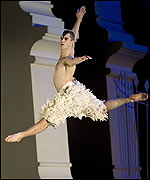 | | Matthew Bourne's Swan Lake (Pic: Brian Cooper) |
Blending dance, humour, mime and character comedy, he has created a Swan Lake for our times which looks at love, imagination and oppression in a modern context. Widely acclaimed as a landmark achievement it has received over 30 international theatre awards and is now celebrating ten years since its premiere with a UK tour that arrives in Milton Keynes in October. The great man himself, Matthew Bourne, told us where the idea first came from, how it has evolved over the years - and if he really feels like Damien Hirst! Amazingly, this is the 10th Anniversary UK tour of your Swan Lake. Can you believe it? Matthew: No, I can't believe it, but when I think of everything that has happened since it does seem a long time ago! Since its premiere in 1995 it has become something of a phenomenon - the longest running ballet in the West End and then Broadway before touring worldwide. Has this phenomenal success surprised you? Matthew: It was successful when it opened and it's even more popular now that when it opened - that's just how the audiences have gone. I'd be crazy to say I wasn't surprised but it was just SO surprising. It was truly groundbreaking - firstly [a ballet] going into the West End which is the norm now - and then winning a Tony award. If someone had said to me before that that it would happen I would have said "don't be ridiculous"! It was an incredible experience for everyone involved - particularly in how the theatrical image of the swan has changed since then. At first people imagined it would be men in drag or in tutus - it's just incredible what has happened. Why did you decide to tackle Swan Lake in the first place? Matthew: The first full length ballet I did was The Nutcracker, before that it wouldn't have occurred to me to do it [Swan Lake], but I really enjoyed doing The Nutcracker and it put the idea in my head that I wanted to do another one.
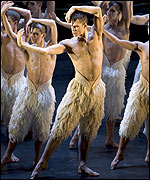 | | Matthew Bourne's Swan Lake (Pic: Brian Cooper) |
Swan Lake was probably the first one that came into my head. I knew it quite well from seeing it at the Royal Opera House and could imagine doing it in a different way. I had always thought it would be interesting if the swans were male and there were also parallels with modern royalty in that the prince needed to be married off to someone suitable - it was all in the papers around that time. So those were the two big ideas. It's not just about male swans though is it? What else do you think that your version has brought to audiences? Matthew: I think it's made people listen to the music again. When you see the same images again and again it tends to dull the music a little. With new images you can maybe see there's a bit of violence here or passion there. So I think that the music has changed for people. It's an incredibly deep psychological story and this all came out of the music. Tchaikovsky had a troubled nature and his music brings this out - his troubled nature is in there somewhere. There's so much feeling in his music. So you have to dig deep and wipe away what has gone before. That was the main thing for me, to wipe away people's previous memories of the piece - then the music can come out again. Here's the obvious question! Why did you decide to have male swans? Matthew: Well firstly there was the physical thing. When I watched swans they seemed more masculine than feminine. They are feminine when they are gliding gracefully on the water, but when they are landing and are out of the water they seem more powerful and have a different feeling. I thought that with a male dancer you could show these two sides. Then there was the troubled Prince. I thought it would be interesting to have a male swan and flock who would represent an image of what he couldn't be - wild and free. Imagine that the white swan represents an image and he falls in love with that image and what it represents. Then the black swan is like the bad voice. This made it a more interesting story for me. So he loves the image of what he could be rather than the actual swan? Matthew: It does turn sexual in the second act when he recognises the swan as a free spirit. But it's not a straightforward case of him being gay and falling in love with another man because it's a swan as well.
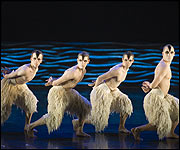 | | Matthew Bourne's Swan Lake (Pic: Brian Cooper) |
In Act Three he [the swan] is introduced as a real person and the Prince sees in him qualities that he's only dreamed. Then he embarrasses himself by showing desire to this person and because he is royal it becomes a scandal. But it's not just about one thing or another - it's not just about sexuality. We even give him a girlfriend in the first act but she's a third rate celebrity and not right for him - you know the type! So again it's about finding someone suitable for a prince. It does seem like there are some parallels with Prince Charles' situation? Matthew: Yes it's true of Prince Charles who has finally been allowed to marry the person he loves. It's just a shame it doesn't work out too well for our Prince. It was definitely a happier ending for Prince Charles. After 10 years, how has this version changed? Matthew: Over the years it has changed. The choreography is stronger now and we have new costumes in Act Three which are now far more recent catwalk fashions. Those who have seen it will still recognise it but I think it's much richer both in design and in character. Is there a lot of pressure on a new cast being in such a legendary production? Matthew: They do feel it yes because there is now that element that they have to reach a certain standard but it's a wonderful experience for them because the audiences go crazy. It doesn't matter how they [the audiences] have been through the show they always go mad at the end. It's a big roar and it's amazing for any performer to feel that every night. They then know that they are part of something special but it is daunting for them to begin with. Do you think that this production has encouraged there to be more male dancers? Matthew: I know it to be true in many cases - it inspired a lot of men to dance and a lot of them now work for me! They first saw it [Swan Lake] ten years ago in their teens and it became their ambition to be in the company and now they are doing it. But this is a show that many guys love to do because they can show many sides - it's very masculine but also lyrical and romantic as well. You have been described as the Damien Hirst of British Dance. Would you agree with that? Matthew: No! It's just something to write that sounds good but it's a misconception. My values about performance are old-fashioned. I like to tell a story, I like the audience to understand and I like them to have a good time. I care very much about the audience and what they want, I don't just throw my work out there to be shocking. I started late - at 22. People are always asking me when were you at "the school" they always assume I was at the Royal Ballet School but I wasn't - so I can't be "of" ballet if I'm not "of ballet". I have been called the Noel Coward of dance though and I quite like that! Do you think that anyone can be taught to dance? Matthew: Yes and no. It depends what sort of dance you mean.
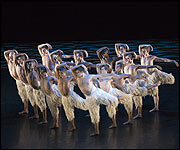 | | Matthew Bourne's Swan Lake (Pic: Brian Cooper) |
I have worked on musicals where there is a very mixed bag of people so I have dealt with many actors, and you can always teach people to do something unless they've got no rhythm at all or they can't count. You can get something that feels natural to them and get them to feel wonderful, especially kids. I've worked on Oliver and Mary Poppins and there's no feeling of "I can't do" with them. They just do what you show them in a very individual way which
is also very charming. It's wonderful to watch. It's sometimes just about confidence - people often think they can't dance - so they don't. You seem to run a very happy ship at your New Adventures company? I have spoken to Associate Artists Scott Ambler and Etta Murfitt before and they always say what a joy it is to work with you. Matthew: There's a lot of loyalty amongst the performers, some of whom have worked for me for years. We don't have the funding to take them on full time, it's all on a contract by contract basis, but sometimes that's good because people feel that they have made the decision to continue so it gives them responsibility. I treat people like individuals. I am celebrating individuality - it's a company where there's a place for everyone, they are not all clones and we respect their individual talent. I treat them like actors in that they can develop their characters. I get them to be creative and make it their own. I make it known to them that I am always open to their ideas. If you weren't in the dance business what do you think you would be doing now? Matthew: I think I would be in the entertainment business of some kind as I was into it from a very early age. I was a great autograph collector at one point with a great knowledge of people so I might have been a casting director or something. That's what I was thinking of in my teens. But I can't imagine doing anything else now and I'm very lucky and privileged that I don't have to think about anything else. But I am surrounded by dancers who do have to make those sorts of decisions. It is a very short career just as you are at your height, and when you get to your best you have to think about retiring. So I'm very lucky that I am able to carry on in this way! |