| 13 November 2014 |

|
|
| BBC Homepage | | |
| |||
| Contact Us | | |
Local HistoryYou are in: Stoke & Staffordshire > History > Local History > The Staffordshire Regiment 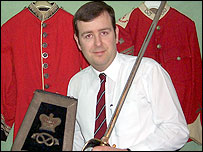 Dave Cooper The Staffordshire RegimentBy Dave Cooper More than three hundred years ago - on July 29th 1705 - the long history of The Staffords came into being. Local man Dave Cooper has put together a history of the regiment, almost up until its merger into The Mercians. Here he tells us more... I became fascinated and absorbed with all aspects of military history over 30 years ago, but in particular, aspects focusing on the county of Staffordshire, especially the Imperial Regiments of Staffordshire up until the end of the Great War. I was continually disappointed that there was not a detailed reference book in just one volume. So I decided to write one! Prince of WalesThere were quite a few early manifestations of the regiment - the Volunteer Regiments. and then the later county regiments, either as the North Staffordshire Regiment (The Prince of Wales’) or the South Staffordshire Regiment, who both, after the Second World War, themselves merged into one Staffordshire Regiment.  Soldiers from the Staffordshire Regiment The photos of known casualties, funerals, pictures of war-weary survivors of the remnants of decimated Staffordshire Regiments in the 1914-1 War are in stark contrast to those of fresh faced raw conscripts and recruits who would be initiated by a baptism of shot and shell on the Western Front in particular, and to which many would inevitably and eventually succumb. The Staffords also served in many other theatres of operations: the 2nd North Staffs on the North West Frontier of India, the 7th Battalions of both the North and South Staffords in the Middle East for some of their Great War service, and the Staffordshire Yeomanry in Mesopotamia fighting the Turks. It is even more poignant now that the amalgamation of the Staffords with other regiments has taken place. Sir John Fortescue, a famous Army historian, once said of the South Staffords: "One could not help reflecting that if this Regiment wore the kilt, the whole British Army would ring with its fame". 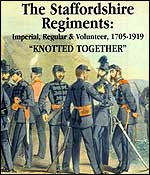 The Staffordshire Regiments 1705-1919 Labour of loveThe compilation of my initial book 'Knotted Together' was a long and demanding task involving many hours of study, reflection, writing and re-writing. Over seven years of research and compilation went into "Knotted Together", and it has been a labour of love, and my self-imposed task for many years, preceding my initial published articles in the Armourer Magazine, and will continue long after the publication of the first edition of this work. I consider myself in no way an expert, only a knowledgeable student. It is certain that I have not got everything correct, and experts in particular fields will wish to differ from my assumptions and findings. Other worksIt is over 300 years since Colonel Luke Lillington formed his Regiment of Foot at the Kings Head public house, in Bird Street, Lichfield in 1705, that went on to become the 38th Foot (1st Staffordshire Regiment), and it was decided to commemorate the tri-centenary of the first Staffordshire Regiment (in 2005) with a volume "The Staffordshire Regiments: Volume II, "The Scrap Book". This is more of a visual book than my first volume - "The Staffordshire Regiments: Imperial, Regular & Volunteer, 1705-1919 - Knotted Together". In the initial months of the Great War of 1914-1918 the group photographs convey the relaxed feeling of the officers and men of the various Staffordshire Regiments, confident in the fact that "it will all be over by Christmas 1914", totally oblivious to the ordeal, death and destruction to come! The photographs recording the initial bravado and enthusiasm of Staffordshire soldiers going to the front lines, although they melt into photographs illustrating the stark reality that The Great War was going to be a long, drawn out savage reality. The 1st and 9th Battalions of the South Staffords were eventually ordered to the Italian front and some unique photos show the stark difference of terrain between the Italian Alps and the featureless, desolate shell torn muddy morass that was often the Staffordshire soldiers home and tomb on the Western Front of France and Flanders. FutureA special thankyou is owed by me to H.R.H. The Duke Of York (Prince Andrew), Col. The Staffordshire Regiment (The Prince Of Wales’s) for his foreword. But, it is a continuing task of work, and I urge anyone to contact me if they have any material relevant to the Staffordshire regiments. Dave Cooper** Related sites: please copy these links into your web browser address bar. Dave's book is available through bookshops or from the publishers Churnet Valley: http://leekbooks.tbpcontrol.co.uk If you have any information you wish to pass on you can email Dave at: davercooper@antique-armoury.freeserve.co.uk last updated: 02/07/2009 at 08:18 Have Your SayYour thoughts on the Staffords?
Pauline Simcock
Chrissi Shaw
Richard Yates
MRS L BLAKE
Staffs Regt Museum
Staffs Regt to disappear
Disbanding of The Staffords You are in: Stoke & Staffordshire > History > Local History > The Staffordshire Regiment |
| | About the BBC | Help | Terms of Use | Privacy & Cookies Policy |