Theatre-goers can experience something of live kinship with indigenous, rural people, authentically represented by an inspired 'family' of actors, The Hampstead Theatre Company, directed with insight by Lucy Bailey. The play is grown out of our soil, ripened in our orchards and fermented among farming folk, having been created by Glastonbury-born author Nell Leyshon. Old values and blood-ties versus young liberality and soul-searching: the story is more about family disfunction and 'knots in the apron strings' than about agriculture. It's about inhibiting bonds of emotion versus the pull of irresistible desire to be free - to find a decent life not cramped by tradition, and to seek love beyond close family. A visual feast Before the actors intrude, the stage displays a timeless quality of rustic dilapidation.
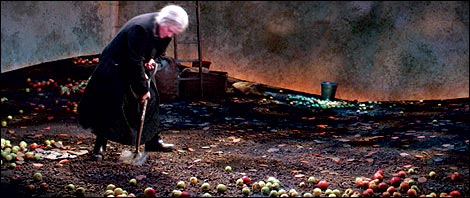
Lighting, sympathetically designed by Oliver Fenwick, seamlessly accords with the set to create a satisfying visual ambience, looking like an old, painted masterpiece. But more, this visual feast is enhanced throughout the performance by empathic music and sounds, composed and designed by the well-respected Nell Catchpole. Here are combined all the elements that make live theatre an enjoyable experience, entirely different from watching screens large or small. A keen nose will also relish the scent of countless Somerset apples that decorate the stage. The scene on stage is simply created by Mike Britton's ingenious design: an undulating floor contained within an unbroken, mud-plastered cottage wall, through which a historically perfect small window lets in autumnal sunlight. The wall serves to contain the primitive interior of a bedroom and little-used parlour, with centre stage being a farm kitchen in which upturned furniture and broken plates suggest violent domestic upheaval. Souls in torment This turmoil is explained in embittered, grieving altercation between old Irene and her simpleton younger brother, Len.
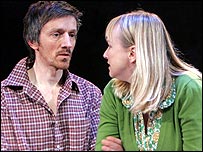
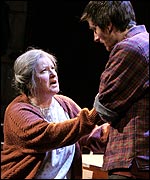
Veronica Roberts magnificently sustains the semblance of age to become the ageing farmer's wife, newly and suddenly widowed, while Len is amusingly and inventively played by the fairly youthful, Graham Turner. Roy, Irene's darling son, enters angrily, confused, bereaved and heartbroken, every emotion conveyed through his tautly energised but controlled body language and scorching diction. An actor well in command of himself and his character, Jonathan McGuiness makes a fine, catalystic contribution to the play, especially when confronting his women: Brenda, his outcast sister; their mother, Irene; then, no less touchingly, his former lover and one-time friend of all the family, Linda. The intensity between Nell Leyshon's well-drawn characters is cathartically relived through the script, at times seeming repetitive and shy of delving so deeply as emotion might demand, but in that lack, revealing the agonies, unspoken and unspeakable, that so often inhibit communication between even the closest souls in torment. An emotional journey
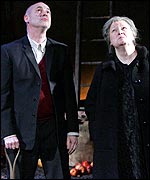
In Act Two, the set equally convinces as the outdoor side of the pink-washed farmhouse wall, even the door, reversed during the interval, now opens the opposite way. Appropriately, three tall, decrepit ladders rising into the dark above the apple-strewn stage, suggest an orchard of neglected trees. Revelations, heartbreaking choices, pleadings and reconciliations hasten the play to its thoughtful, sad closure, leaving Irene and her uncomprehending brother to recite their fading superstitions and enact the ancient rituals of their childhood games until their end of time on the earth. Comfort Me With Apples is an emotional journey well worth sharing. The play runs until Saturday, 31 March, 2007 |