This famous tale of livestock insurrection and regime change in an agrarian community is engagingly performed by one creature on two legs, Gary Shelford. Despite this impediment, he's not at all 'bad'. In fact very 'good' at impersonating the four-legged beasts and winged fowls, especially when he adds the role of Squealer, one of the leading revolutionary pigs whose voice and manner is uncannily like those of working-class hero, Tony Blair. By such, and subtler modern references, the play is made as relevant today as in 1945 when Orwell wrote Animal Farm. The author had before then served the failing British Empire in southeast Asia, then the doomed cause of democratic socialism in Spain. In WWII, he joined the hopelessly inadequate Home Guard. So, by the end of the war, Orwell was a very grumpy middle-aged man. As Britain was electing the Labour party with an overwhelming majority in Parliament, Orwell set out his grim warnings of the political future in Animal Farm and later 1984. It's doubtful he could have imagined Big Brother becoming so popular in the 21st Century. Orwell's youthful, Etonian optimism had evaporated in the tropical heat of Burma, in the hostility of the Spanish civil war, and mostly in the stifling, murderous intrigue and betrayals that characterise political ambition. He saw in Franco, Stalin, Mussolini and Hitler (and in many other 'little Hitlers') that leaders thrown up by popular revolution (or democracy, even) were likely to consolidate their power by ruthless control of the very people who had elevated them to power and self-indulgence.
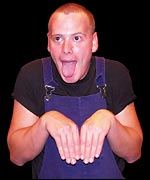 | | Gary Shelford |
With the relentless energy and unswerving determination of a Boxer (the workhorse in Animal Farm, that is), Gary Shelford switches instantaneously between a dozen or so animal characters, with graphic body language and varied voice, also filling in as a human narrator between the dramatic bits. Like Boxer, Gary couldn't have "worked harder" if he'd wanted to, yet was never overstretched, despite putting his every fibre into performing Orwell's allegorical tale. Strolling onstage like a farm hand, chatting to his audience, setting the scene, Gary immediately became our mate, our pal, nay, 'comrade' - more storyteller than actor, before slipping easily into animal mode, first as the wise old boar, Major, with his egalitarian philosophy; then as brutish bully-boy Napoleon and spin-doctoring Squealer. Gary's vocal range is augmented by choruses of cows, sheep, chickens and dogs over the loudspeakers, but the individuals Gary enacts are both moving and amusing, as appropriate - especially Molly the shameless, capitalist lackey, tart-pony. Ben the cynical donkey (most streetwise 'cos he's been around more years than the others), the loyal horses Boxer and Clover, the brainless sheep, bickering hens, passive cows, savage dogs, the idle opportunistic cat, as well as the odious farmers are all convincingly brought to life in Gary Shelford's energetic performance. And many die heroically, in Orwell's graphic description - movingly spoken by Shelford - of the farmers' treacherous attacks, representing support given in the costly (and carefully forgotten) civil war, waged in the earliest years of the 1920s, against the fledgling USSR by those champions of democracy: America, Britain and other European states. Masterson's super adaptation retains Orwell's novel in all its essentials and the story line never flags, but credit for the excellent directing goes to Tony Boncza, who keeps it simple and sufficiently light-hearted so the tragic story never becomes morbid. Lighting and sound, under the control of Suzie Foster, were also very effective, helping Gary's vivid words and action to fill the bleak stage and paint the black drapes imaginatively with herds and flocks in barn, farmhouse, even the wondrous windmill. |