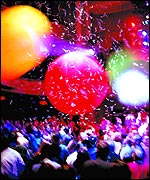
Grown men and young children played with giant balloons that bounced around the auditorium. Almost everyone in the main house of Bath's Theatre Royal became involved with the performance at some stage. Whether it was brushing the snow off their clothes, blowing bubbles away from their faces, pulling cobwebs from their hair or being splashed by clowns carrying umbrellas as they leapt from seat to seat, Slava's Snowshow gives a whole new dimension to audience participation. Exaggerated earflaps and elongated shoes Developed in 1993 in Russia, the show has toured the world several times over and is in Bath for a week before moving to Italy. I pinched myself when it began. How could I have missed this theatrical phenomenon?
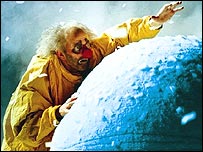
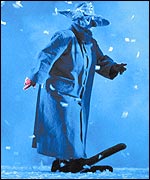
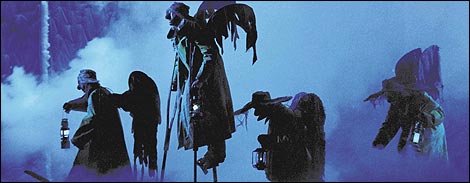
The theatre was packed, with standing room only at the back. The audience was a mixture of school children, families, lots of teenagers, and groups of young women and men. It wasn't a pantomime audience, but there were fewer of the grey-haired brigade (like me) than normal for a Theatre Royal performance. The show is a series of scenes featuring a cast of clowns. Slava Polunin, as the eponymous Slava, was dressed throughout in yellow while the supporting clowns wore long grey coats, hats with exaggerated earflaps and elongated shoes. The scenes were defined by dramatic changes in music and lighting. The music ranged from classical to Eastern European folk music, an area that seemed to be at the heart of the style of much of the drama. Finding the child in all of us The opening scene featured a suggested suicide with a long piece of rope and noose resembling a moment from Beckett's Waiting for Godot. Two clowns attempt to take possession of the endless rope which disappears off stage. There is a conflict over who owns the rope, a theme which is repeated through the evening. The feeling that resonated the most, though, was of the clowns finding the child in all of us.
They would squabble over props, play with giant balloons, be frightened of noises, want to be noticed and demand love in a series of actions which had no recognisable words, but relied on gesture, body language, facial expressions and movement - the clowns' coded universal language of communication. If you were deaf or blind, the show would still have connected in some way. It was very sensory, with those primary colours, shapes, sounds and movements we all remember from infancy. The scenes were stunning. A bed becomes a boat, with a sail as two clowns set off across the seas. They are interrupted by a knocking sound which breaks their game up. A clown says farewell to a coat and hat in a poignant moment in which we become convinced the coat is alive. A five-star production Giant balls, bubbles and balloons emerge from the backdrop in time to music and stunning lighting, a blizzard blasts the entire audience into submission with a powerful wind machine and blinding stadium lights.
And did a giant bird fall from the sky as we were enveloped in a blanket of snow? This and other half-seen images kept you wondering what you were experiencing. The interval and the show's finale were so undefined you were never quite sure whether to leave your seat. It was one of the many unusual aspects of a show that kept you guessing as to what it was about - the nature of play? Intrigue in the unknown? Or the enjoyment of being a curious child? Slava's Snowshow has a universal language that appeals to the child in everyone, anywhere, anytime. It's a five-star production that changes the way you see the world and reminds you we are all still curious playful children beneath our nine-to-five exteriors. |