|
At
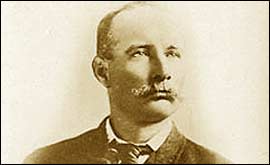
10.41am on Wednesday 25th August 1875, Captain Matthew Webb picked
himself out of the choppy waters of the English Channel and made
his way onto dry land - French soil.
Almost
22 hours earlier he had entered the channel at Dover and begun swimming.
As
the first man to swim the channel, Webb became an instant celebrity
and public hero overnight. Everywhere he went, crowds turned out
to welcome him.
Webb
was born in the mining village of Dawley on 19th January 1848, one
of eight children of a local doctor.
From
an early age he wanted to go to sea - a common ambition for many
young boys of the day - but Webb was different. To start with he
was an incredibly strong swimmer - he'd learned to swim in the strong
currents of the Severn - but also he had acquired a reputation for
being fearless.
At
the age of 12 Webb left home to train as a merchant seaman, learning
his trade for two years before going to sea.
It
wasn't long before his swimming skills - at a time when most sailors
couldn't swim - began to attract attention.
 |
|
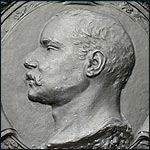
Detail
from the Captain Webb memorial in Dawley
|
In
mid-Atlantic he once jumped overboard to save a colleague who had
fallen into the water - a highly dangerous feat. He didn't find
the missing man, but was awarded £100 - then a princely sum
- for risking his life.
In
1873 Webb read an account of a failed attempt to swim the channel
by J.B. Johnson, a racing swimmer and it changed his life.
He
quit his job as captain of the steamship Emerald and lodged in London,
where he began to train. To start with he built up his stamina at
Lambeth Baths, but as soon as he could he was practising in the
cold waters of the Thames and the English Channel.
Finally,
in August 1875, it was time for Webb to take the plunge - but disaster
struck.
Seven
hours into his first attempt a violent storm blew up and he had
to abandon the attempt.
Twelve
days later he was ready to try again. Backed by a flotilla of three
boats, he set out again, swimming breat stroke into the ebb tide,
which carried him out to sea.
Eight
hours into the swim, Webb was stung by a jellyfish, but a does of
brandy helped him continue. But dawn saw him fighting the tide as
he attempted to reach Cap Gris Nez on the French side of the channel.
For
five hours he swam along the coast, waiting for the tide to abate
and becoming increasing desperate. Eventually the tide eased and
an exhausted Webb was able to make landfall at Calais. He'd swum
39 miles.
Webb
never returned to a life at sea, and made a good living as an exhibition
swimmer, at the same time attempting the odd race against other
daredevil swimmers - and doing some circus-style stunts that usually
involved him staying in water for a very long time.
He
married Madelaine Kate Chaddock in 1880, but it wasn't long before
he was pushing the boundaries again.
His
next stunt was to be a truly dangerous swim across the rapids at
Niagra Falls - a feat many considered suicidal.
At
4.25pm on 24th July 1883, he jumped into the river from a small
boat and began his swim. Within 10 minutes he had become caught
in the current and was dragged under by a whirlpool.
His
body was found four days later and buried at Oakwood Cemetery, Niagra
Falls.
In
1909, Webb's older brother Thomas unveiled a memorial in Dawley.
On it reads the short inscription: "Nothing great is easy".
|