| 24 September 2014 |

|
|
| BBC Homepage | | |
| |||
| Contact Us | | |
places_featuresYou are in: Shropshire > places > places_features > Local primary schools face uncertain future 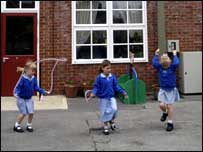 School children Local primary schools face uncertain futureAs the number of primary school pupils falls in Shropshire, council bosses propose radical measures that could see 22 schools close and another 16 merge. Proposals to close 22 village schools and merge a further 16 have been opposed by campaigners. A meeting of the Cabinet on 30 January decided to suspend the consultation exercise for the 22 schools proposed to close. However, consultation will go ahead on the 16 schools due to merge. On Wednesday, 23 January Shropshire County Council bosses revealed the list of primary schools they planned to close or merge. Catch up with the latest on the story online in our news section. Village educationThe number of primary school pupils has been falling in the county over the last decade. Shropshire County Council and local teachers have been forced to face up to the very real possibility that 25% of all primary school places could lie vacant within five years: that's 5,450 empty seats. Among Shropshire County Council's plans is an entitlement to a primary school place within six miles of a child's home (or within two miles in urban areas). Infant and junior schools could also merge in larger towns (except where the number of pupils would exceed 420). Schools are expected to have either four or seven classes (7 or 14 class schools in large towns). County councillors voted in favour of the proposals on 14 December, after the cabinet issued its approval on 28 November. The decision was taken despite the urging of a council scrutiny panel, which asked the cabinet to reconsider its policy following public meetings in Craven Arms, Cockshutt and Shrewsbury. The panel also believed that there was a lack of information about how much money will be saved. FundingCurrently each primary school pupil attracts around £3,500 of central funding a year - that's over £300 less than the English average. Like many other shire counties, Shropshire loses out as central government pumps extra funds into run-down urban areas. Conservative MPs Owen Paterson and Philip Dunne, whose North Shropshire and Ludlow constituencies cover some of the county's most rural communities believe that bringing Shropshire's funding in line with the England average (an extra £12.7m) would instantly solve the problem. Owen Paterson argues that the problem is caused by "the government's refusal to understand the cost of delivering public services in thinly populated rural areas." Meanwhile, for Shropshire County Council, the problem is that falling pupil numbers inevitably means less total funding. If the trend continues, the county council projects a £3.8m shortfall by 2010. The council's Portfolio Holder for Children's Services, Ann Hartley says that something must be done: "Staying as we are is unfortunately not an option."
Radical measures are being proposed that will affect hundreds of families across the county and see around 22 primary schools closed or merged. About 1,100 people took part in a much-criticised consultation exercise. Parents discovered which schools faced the chop on Wednesday 23 January and each school now faces a consultation process. The recent experience of Grafton Primary School's move to the new £3m Bicton Primary suggests that merging some village schools can work. However, many villages are isolated, and the local school often provides the main focus for the community. Some teachers and parents fear that removing a school might also mean removing the heartbeat of the village. Ian Terry, the Church of England's Director of Education for the Diocese of Hereford (which covers South Shropshire) voices a similar concern: "The school is at the heart of the village... If the school feels that it is under threat, that's a threat to the life of the whole local community." As Telford and Wrekin's population continues to grow rapidly (expected to rise to 189,000 by 2021), the area is immune from the problems affecting the rest of geographical Shropshire. An ageing populationSo where have all the children gone? Recently the Office for National Statistics (ONS) announced that Britain's population is expected to hit 65 million by 2016, and Shropshire's population is also growing. The ONS sub-national population projections estimate that Shropshire's population will grow by 12% (34,700) 2004-2029 to a total of 322,600 people, with migration playing a leading role. However, the UK (like many other countries) has an increasingly ageing population. According to the 2001 census children under 16 make up 20% of the UK population (compared with 26% in 1971). While Telford and Wrekin exceeds the national average, with 22% of the population under 16, Shropshire lags behind with just 19.1%. Inevitably some areas of Shropshire have younger populations than others. Bridgnorth District Council's area has the lowest percentage, with under 16s making up just 17.5% of the total. In Oswestry Borough that rises to 20.2%. last updated: 30/04/2008 at 11:59 Have Your SayHow do you feel about plans to close or merge up to 20 local primary schools. How would it affect your area? And how would you deal with the problem?
R Morris
Philip Osborne
Victoria
Nikki Tildesley
Robert Lopez
Emma
Chris Endacott
Tony Bromwich
P.R.
Chris Endacott
David
Kate H
Linda A
Oswestrian
ShropshireLadd
Jemima Willis
Amanda Millington
jane armstrong
Alison Arrowsmith
Nicchi Cannon
L H
Colin T
derek isaac
A.C. Observer
Shropspy
Jo Tucker
Steve Barras
tony harris
Nicchi Cannon
Nick Gallagher
Jennifer Millward SEE ALSOYou are in: Shropshire > places > places_features > Local primary schools face uncertain future 5 DAY FORECAST
The latest forecast for your area from BBC Weather
[an error occurred while processing this directive]
|
| | About the BBC | Help | Terms of Use | Privacy & Cookies Policy |