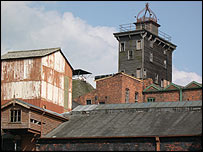
Lying empty since it was finally abandoned as a maltings in 1987, the Ditherington flax mill has been slowly decaying through neglect, lack of investment and vandalism. The flax mill is important because it the techniques used in its construction make it the original skyscraper - it was the first ever iron-framed building.
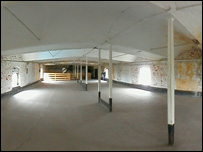 | | Inside the flax mill |
The construction dates from 1797. It was designed by local engineer Charles Bage for flax spinners John Marshall and Thomas and Benjamin Benyon. The technique proved successful, although time has revealed shortcomings. For instance Bage wouldn't have realised that an iron beam supported at the centre would bend and eventually crack without warning. In March 2005 English Heritage officially bought the building for an undisclosed fee, thanks to grant funding from Advantage West Midlands. In 2004, emergency repairs totalling around £2 million were undertaken. However, the mill remains in a critical condition and architectural work is being performed to assess the state of the structure. The long-term future for the flax mill may now look a little rosier, but the final vision is still unclear. It is likely that the building will eventually perform a variety of uses, including public access, residential and commercial.
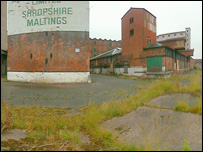 | | Outside the flax mill |
Like other historic buildings, the flax mill will have to pay its way - only by generating its own revenue will the long-term future be guaranteed. However, that doesn't necessarily mean that the mill's unique history will simply be sold-off to the highest bidder. Balancing the potential and demands of the building, as well as maximising its value to the community, is no easy task. However, you don't have go far to find inspiration. A few years ago, the Shrewsbury Old Market Hall, another Grade I listed building, was also on the BAR register. However, following a £1.7 million restoration it's now a unique and popular arts/ digital media centre. The market hall's restoration has also had its detractors, who preferred not to carve-up the stunning internal structure. However, it continues to attract a huge number of visitors and more than earns its keep... as well as being simply one of the most beautiful venues of its type in the country. The flax mill is a much greater proposition. Not only is the main building considerably larger, it's also surrounded by other, associated structures, some of which are Grade II* and II listed. The Old Market Hall also bears a message of warning - opening in January 2004, it was considerably both over budget and behind schedule. The scale of the flax mill (and its needs) mean that any investment plans must be thoroughly investigated. The Old Market Hall's restoration also displayed the value of public consultation and the readiness of locals to claim ownership of the finished article. |