|
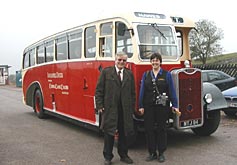
Richard Uridge trundles round the Eden Valley in Cumbria in a vintage red bus with Will Hamer, its driver, and his daughter Alison Morris, who's the conductress. It's a regular summer bus service between Ravenstonedale and the Tuesday market at Hawes.
Richard's first stop is Kirkby Stephen which, despite its population of 1600, still proudly calls itself a village. This year it's the 650th anniversary of its market charter, and it remains the commercial centre of an area long dominated by sheep farming. The village is at the edge of some relatively low-lying land between the Lake District's Cumbrian Mountains, the Yorkshire Dales and The Pennines. However, the inhabitants of the town and surrounding area are West Merian (from Westmorland) and very proud of the fact.
Richard meet Margaret Gowling, from the Upper Eden History Society, who explains that the 1353 charter was granted by Edward III on the understanding that Robert de Clifford, Baron of Westmorland, would supply soldiers to fight the Scots. For local people it was a chance to make money and at the same time throw off the drudgery of their normal lives. At this time Kirkby Stephen was very much on the edge of the kingdom of England. The early wealth and importance of Kirkby Stephen has much to do with the north to south droving routes that passed close by. Some droving routes have existed since Roman times, but there is also evidence to suggest that cattle were being driven south from the Scottish glens to be sold for fattening in the Dales area as early as the 14th century. This trade had increased to fantastic proportions by the 17th-18th centuries, but it was in medieval times that the UK wool market expanded rapidly, thanks to a strong foreign interest in English wool.
Richard takes the bus on to Outhgill where Dick Capel, project officer for East Cumbria Countryside Project, is waiting to show him a Cone Pinfold - one of the sculptures made by the landscape artist Andy Goldsworthy for his sheepfold project. Andy creates sculpture from materials he finds in the landscape. A lot of his work is temporary, left to degrade or fall down once it has been photographed. The sheepfolds he has created in the Kirkby Stephen area are much more permanent. Cumbria Country Council asked Goldsworthy to undertake a major landscape commission in 1996. He picked on the idea of rebuilding or altering sheepfolds (at first the target was 100, but the figure was revised down to 50), many of which were ruined, in disrepair or simply marks on a map. Goldsworthy stamped his own style on the design of all the sheepfolds and has worked with professional dry stone wallers to create an unique mark on the landscape. All the sheepfolds are on private land, but the public has the right of access.
Goldsworthy sheepfolds
At nearby Crosby Garrett, Richard meets Ian Allonby who's passionate about poultry. He's a prize-winning breeder of poultry and waterfowl and started breeding bantams and poultry when he was seven. Amongst his fowl are Peking bantams, a dwarf mini-fowl brought to England after the 1860 sacking of the Summer Palace in Peking; Indian runner ducks, introduced from Malaya in the 19th century, initially by a ship's captain who bought a few home and distributed them among his friends in Dumfriesshire and Cumberland; and Old English peasant fowl, developed in the 18th century and regarded as a capital layer, fine forager and ideal for small holdings.
Poultry Club
Poultry Pages
Will Hamer and Alison Morris drive home, where Richard finds that the red vintage coach he's been travelling on is not the only one in their garage. Will's love of classic buses and coaches started in the 1970s when he was living in Manchester and a builder by profession. Will now has six coaches and Public Service Vehicle licences for four. The scheduled services attract a mix of local people, curious tourists and classic coach enthusiasts - the company has a 400-strong fan club and sends out a regular newsletter. Alison's passed her test to drive the buses and finds it exhilarating to be in charge of these great beasts of vehicles with no synchromesh on the gears. They've all got names, of course: there's Florence and Heather and Richard finds he's been travelling on Lawrence of Arabia all day. But the family are stumped for a name for their little blue and cream coach. Listen to the programme for some clues, and then drop us an email with your suggestions.
Cumbria Classic Coaches
Email Open Country: open.country@bbc.co.uk
The BBC is not responsible for external web sites
|