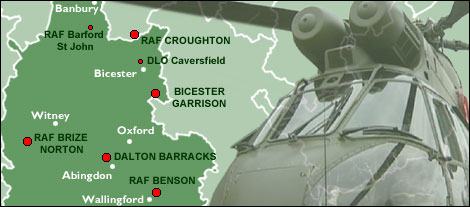
Click to see a gallery of pictures from RAF Brize Norton
and RAF Benson

|
Military
bases and personnel across Oxfordshire are playing their part in
the war.
 |
| President
Bush flew into Brize Norton two years ago |
RAF
Brize Norton
A royal
visit to Brize Norton in the early days of the war is an acknowledgement
of the importance of the RAF's biggest air base.
RAF
Brize Norton is home to 4,500 personnel - several hundred of whom
have been sent out to the war zone.
This
is the RAF's main transport centre. It is also home to air-to-air
refuelling craft.
Its
ageing Tristars and VC10s are the petrol stations of the skies.
They
can carry up to 100 tonnes of fuel.
Without
them, strike aircraft such as Tornadoes, Harriers and Jaguars cannot
stay in the air long enough for long-range missions.
They
are being used to refuel both RAF and US Air Force aircraft.
The
Base has 550 personnel in the Middle East, including 400 air and
ground crew and 100 from the Tactical Communications Wing, which
deals with air traffic control.
The
base is also continuing to supply forces in the Gulf with stores,
using its own Boeing C-17 Globemaster transport planes and aircraft
chartered from private operators.
 |
| RAF
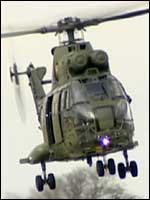
Benson has sent seven Pumas to the Gulf |
RAF
Benson
Benson
is home to three helicopter squadrons.
The
base has sent seven Puma helicopters from 33 Squadron, along with
200 personnel.
The
Pumas have been sent to ferry troops and supplies into the battle
zone.
They
will also bring out any casualties.
A single
Puma can carry up to 16 fully-equipped troops, or lift up to 2500kg
of freight attached to a cargo hook beneath the aircraft.
It
can be armed with two general-purpose machine guns for self-defence.
It
is equipped with night vision aids, defensive electronics and advanced
navigation equipment.
Reports
from the war zone have told how helicopter rotors are sucking up
sand that damages their engines, causing an extra maintenance burden
for ground crews.
Bicester
Garrison
|
 They have 7,500 days' worth of rations
Click
here
to read more
|
Soldiers
from the 23 Pioneer Regiment of the Royal Logistic Corps - based
at Arncott and Graven Hill - were initially sent out to the Gulf
to set up bases and camps.
But
within a week of the war beginning, they were given a new role,
delivering humanitarian aid - though there were problems at first
because the supply ship HMS Sir Galahad was delayed by mines.
The
Army has declined to say how many members of the regiment have gone
to the war zone - but it is a significant number.
RAF
Croughton
The
US Air Force communications base sits just over the county boundary,
but many of its personnel live in accommodation at Bicester.
It
also has a satellite station at Barford St John, near Bloxham.
RAF
Croughton is home to 422 Air Base Squadron, which operates one of
the biggest military telecommunications switchboards in Europe.
It
handles a third of all the US military communications in Europe.
It
continued to operate without a hitch during the terrorist attacks
of 11 September 2001, when civilian communications in America were
overwhelmed.
It
will play a crucial role in the conflict.
Dalton
Barracks
Only
a handful of personnel from Dalton have gone to the war zone - filling
in gaps in other units.
Dalton
is home to two regiments of the Royal Logistic Corps: 4 General
Support Regiment and the more-specialised 3 Close Support Regiment,
which operates nearer to the front line.
Neither
could not be spared for the conflict because they have been providing
emergency cover during the fire fighters' strikes.
"When
a fire strike is called the camp empties because the both regiments
are involved very heavily," says Captain Rachel Parr, adjutant
of 3 Close Support Regiment.
The
role of Dalton's 1,400 personnel is to deal with transport - "getting
the right kit to the right place," says Captain Parr.
That
work is being done in the Gulf by two sister regiments based in
Germany.
But
the Dalton regiments could have a future role in the Gulf once the
conflict is over - assuming the campaign is short.
Defence
Logistics Organisation Caversfield
The
DLO handles the clothing and textiles needs for all the UK armed
forces from its Caversfield depot, on the northern edge of Bicester.
It
places orders for supplies then sends them to military units to
be handed to personnel.
Its
work has not changed as a result of the conflict with Iraq but has
become "more intensive", according to a Ministry of Defence
spokesman.
|