Hailed as a “biting expose of Britain’s new underclass” Blame invites the audience into the world of poverty, destruction, deprivation, drug abuse and neglect that has become so synonymous with the urban landscape of Britain today. A council flat in Hackney provides the setting for the tragic story of Mandy (Lindsey Coulson), a single mother battling with unemployment, a persistent drug habit and a broken front door which has been off its hinges for weeks. | "Blame boldly takes the stereotypes so often ridiculed in today’s satirical comedies and delves beneath the surface to reveal ... real social problems" | |
Left without any barriers against the depravation beyond her rotten door frame Mandy has all kinds of visitors – Dwayne the drug dealer (Nicholas Beveney), his pregnant teenage girlfriend Chantelle (Katie Wimpenny), Mandy’s friend Paula (Sandra Yaw), and her alcoholic brother Raymond and gangster ex-boyfriend Denny, both characters skillfully played by Andrew Paul. Mandy is a broken woman, pitifully unable to protect her young daughter from herself let alone the society which they inhabit. Laikeisha, superbly played by Callie Ward in a noteworthy debut performance, is helplessly caught up in the chaotic atmosphere of her home life – aptly reflected in the short, sharp and frequent scene changes accompanied by sobering loud bursts of urban music. Never really given a chance to escape this pit of degradation she calls home Laikeisha’s young life is tragically cut short before it really has a chance to begin. The Blame game inevitably commences, each character tearing themselves, and each other, apart in an attempt to face up to their role not only within their society but within little Laikeisha’s short life, begging the question who is really to blame?
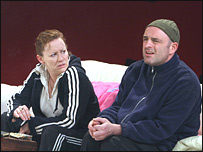 | | Mandy and her brother, Ray |
The professional experiences of the writers Beatrix Campbell, a journalist, and Judith Jones, a social worker, shine through – their clear understanding of the characters and their respective ways of life reflected in the authentic colloquial language which admittedly takes a little time to tune in to. Blame boldly takes the stereotypes so often ridiculed in today’s satirical comedies and delves beneath the surface to reveal multi layered characters caught up in real social problems to which Campbell and Jones are anxious to draw attention. Admittedly this is an admirable and courageous political and social statement propelled onto the stage, making for uncomfortable, albeit somewhat predictable and dare I say cliché viewing in places. We have met these characters many times before, on our television screens and in the headlines, but what is really important here is the story they tell, a story which is all too familiar yet one that demands attention. Sara Beach |