| Performance details | Venue: York Theatre Royal Dates: Friday 7 - Saturday 29 April 2006 Tickets: £8.50 - £18.00 Box office: 01904 623568 |
As the curtain falls at the end of the play, so too does a silence. It is as if a collective numbness has replaced the usual instinctive applause. And although we do clap eventually, the silence is perhaps more telling - the play has provoked feelings and thoughts strong enough to momentarily disable us. Broken Glass sits alongside much of Arthur Miller's work as an American classic, and does everything to reinforce the playwright's reputation as the 'godfather of modern tragedy'. It deals with individuals' internal chaos; their testing relationships with themselves, those close to them and the world in which they exist. In doing so, the play also reflects the life of Jewish migrants in New York during the 1930's - a central part of Miller's own formative years. Set in Brooklyn in 1938, Broken Glass tells the story of a Jewish couple who discover the real state of their marriage when the wife, Sylvia, mysteriously develops paralysis in her legs. On the basis of the family doctor's conclusion that the paralysis is being caused by something psychological, Sylvia's husband, Phillip, decides her illness is connected to her increasing interest in the events unfolding in pre-war Berlin; he fails to see that his deliberate lack of interest in Jewish matters, and the consequential estrangement from his wife, may be contributing factors.
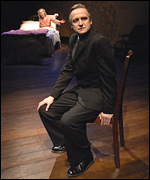 | | Phillip Gellburg turns away from Sylvia |
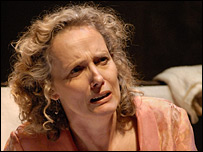
The dialogue between Sylvia and Phillip (excellently played by Barbara Marten and Robert Pickavance) is not only represented through their conversations with each other, but through frequent discussions with Dr Hyman, a confident Jewish man born and brought up in New York. Through the shifting perspectives brought about by these conversations, the audience is able to empathise with the characters as they despairingly grapple with the complex elements of their combined and individual situations. The oppressive and awkward feelings evoked by the play are mirrored in a dark and bleak set. Below a row of high shuttered windows is the space where Sylvia's bed is intermittently swapped for the doctor's desk, and vice versa, in seamless sequences made possible by the Jewish cello music being played live behind a screen. Towards the end of the play, the shutters on the windows are opened, one by one, seemingly signaling a conclusion, an enlightenment of sorts. For Sylvia and Phillip have finally begun to understand one another, even if it's a little late in the day. But frankly, I am left in the dark - the complexity of the play's themes bears down on me, and I appear to have absorbed the mood of the characters. But it doesn't look as though I am alone, and that, I believe, is testament to the success of Broken Glass. Katy Wright |