
A FINE IRISH AMERICAN ROMANCE - By MONA LE STRADE
Transcribed by Stephen Mc Cauley
The way I met my husband, my mother had asked me to go to the Great
Northern Railway station to meet my brother when he was coming home
from Belfast with his little child. You didn’t have cars to ride
around in, you didn’t even take the bus, you just walked every
place. Anyway, my husband,...well...he wasn’t my husband then,
he walked into the station with some other young man and they were just
in plain clothes so I didn’t know he was an American and he asked
me, “What time does the train leave for Belfast?”. I was
trying to be helpful and I said “Well, maybe if you asked the
station manager he could help you”. He didn’t get any help
there so he said, “Could you tell me your name and address because
I’ll be in Derry next weekend and maybe I could see you again”.
I said “My name’s Mona O’Donnell but I can’t
tell you my address because my mother would kill me for giving my address
to a complete stranger”. While he was talking to me, he said “How
come I never saw you before and I’ve been in Derry three years?”.
I said “Well, I always go to dances. Every Saturday night, especially,
I’d be at a dance” and he said, “Oh, I don’t
dance”. So I shouldn’t have bothered with him any further...he
didn’t dance.
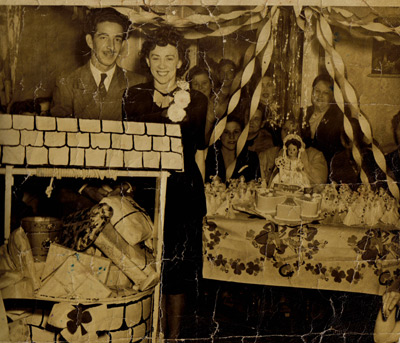
Mona pictured at her bridal shower with husband
Jules Lastrade
Anyway, my brother arrived and had just said goodbye and that day he
went around asking different people if they knew me and in Derry, in
those days, there weren’t as many people as there are now and
I was well known for Irish dancing. So, he asked this young lady did
she know me and she said “Oh, that’ll be Mona O’Donnell
from Elmwood Street, she does Irish dancing”. So, he wrote me
a letter... ‘Dear Miss O’Donnell, if you’re the girl
I met at the station would you answer this letter?’ So, I told
my mammy about it and she said okay and then he came to Derry that weekend
and met the family and everybody. In New Orleans, they would say ‘Miss
Susan’, they wouldn’t just call you ‘Susan’
and they say “Yes ma’am, no ma’am”. That’s
the way they talk there. They’re very laid back people. Anyway,
they all thought he was very nice and then he left to go to the place
where he was staying. The next Sunday we went to church together and
then we left him to the Waterside station, the L.M.S.
I should’ve told you at the beginning, America was not in the
war when he came over from America. He volunteered because he was a
welder. He volunteered to come over to help England out with the war
because they needed electricians and welders and people like that. So,
there were a hundred men that arrived and they were stationed in Derry.
Then he left to go back. America was calling the men back then, so he
was sent away out to the Pacific. Out there, he was in the navy but
I received a letter from him every day for three years and they were
all numbered and so, it became funny in our house because I always got
these letters and my brother Seamus would make fun of me.
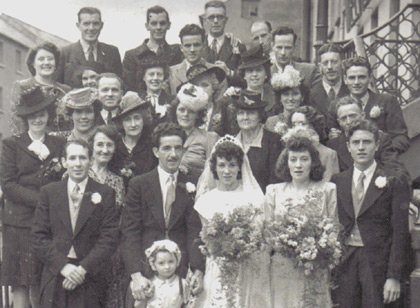
Mona, Jules and Wedding guests
When the war was over, he came back and he bought me my wedding dress
and I have to tell you what that was made from. He was in charge of
the warehouse out there in Guam and he saw a little box, about six inches
square, it was dusty and it was sitting up in a shelf. It must have
belonged to the Japanese. He took it down and opened it up and about
a hundred yards of pure silk just jumped out of the box and that’s
what my wedding dress was made from.
It was like he proposed to me in the letters. It was just one love letter
after another and he was good at writing love letters. Anyway, he was
a very handsome man with black wavy hair, brown eyes and swarthy skin.
He came back and bought me everything for the wedding, the shoes and
everything. I think the box passed all round Elmwood Street. All the
neighbours got to see it and that was funny.
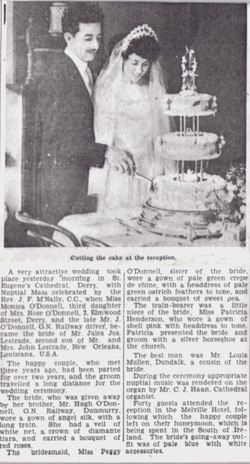
Copy of an article from the Derry Journal
He was going back to America before me because, back then, you went
by number; you couldn’t just go when you wanted. Anyway, I got
on the plane. In those days, there weren’t jet planes yet. I got
on the plane at Shannon airport and as the plane took off, it was about
the 28th November, you could look out and it was like a map, the outline
of the southern part of Ireland. I can’t tell you how sad I was
when the plane was taking off. I just wished I had been there for Christmas.
It was so close to Christmas. The plane took me to New York and then
I had to get the train from there to New Orleans and that took two days.
My husband and his mother and everybody were there to meet me but I
felt like a fish out of water. It was so different. The climate was
different. You just felt like they were different from you. Their way
of speaking, for instance, his mother said, “Did you get her grip?”.
I didn’t know what that was. That was “Did you get her suitcase?”.
New Orleans is right there on the Gulf of Mexico. There’s a song
they sing, I don’t know all the words, it’s [singing] “Jambalaya,
crawfish pie, fillet-gumbo...” and it goes on “...son of
a gun, we’ll have great fun on the bayou”.
He was very romantic, very loving and caring. My husband died last summer
unexpectedly and we were married fifty-six years, that’s a whole
lifetime and he really was a great Irish man because, when he was here,
he was attached to the Royal Air Force and he has a picture of himself...he
was so proud in that uniform, he sent the picture to his mother. It
was in the newspaper. I said, “The people of Derry used to say
‘they’re the glamour boys, the air force”.
<<...back
to stories index









