| 29 October 2014 |

|
|
| BBC Homepage | | |
| |||
| Contact Us | | |
Arts & LiteratureYou are in: Norfolk > Entertainment > Arts, Film & Culture > Arts & Literature > Interview: Chinwe Chukwuogo-Roy 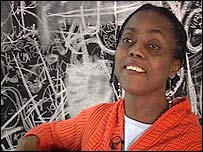 Chinwe Chukwuogo-Roy at the SCVA Interview: Chinwe Chukwuogo-RoyBy Martin Barber As the first black artist to be awarded a commission to paint Her Majesty The Queen's portrait, Chinwe Chukwuogo-Roy admits the honour is a double-edged sword. Speaking as part of Black History Month '07, Chinwe shares her internal conflict. Chinwe Chukwuogo-Roy is one of an elite group of artists who have been privileged enough to win a commission to paint a portrait of Her Majesty The Queen. In October 2007, she was in residence at the Sainsbury Centre For Visual Arts (SCVA) on the outskirts of Norwich, part of the centre's contribution and celebration of Black History Month. Audio and Video links on this page require Realplayer Born in Nigeria, Chinwe moved to the UK in 1975 and started painting professionally in 1989. Now based in East Anglia, Chinwe's work is exhibited in some of the most prestigious public and private collections around the world. Mixed emotionsWhile delighted to be contributing to Black History Month, it is an honour that comes with mixed emotions. "I think of myself as an artist – this is what I am. In society I am looked on first as a black person, before ever what I do, or what am I," she said. 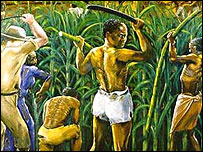 African Diaspora III (detail) "Black History Month has been put in to try and promote black issues. This would never be put in if black issues were taken as part of the normal, everyday discussion or education. "When I'm being written about or talked about it's always 'The black artist that painted the Queen' which I find almost an insult. "I am an artist and I have my work in galleries as an artist, but it's not recognised that I am just an artist – I am still boxed in - which is why there is still Black History Month. "I can also say that I have an issue with Black History Month because we shouldn't be boxed into that. "We should now be recognised in all different walks of life as part of the society, but without having a time to say we're part of society – its really a catch-22 situation. "You cannot do one and be part of society, you cannot do the other and not be isolated – it is just a very difficult situation, but at least it gives us a platform to say we are here and this is what we do." Royal commissionIn 2001 Chinwe was commissioned by The Commonwealth to paint a portrait of Queen Elizabeth II, to mark Her Majesty's Golden Jubilee. The completed work now hangs in Marlborough House alongside her painting of Chief Emeka Anyaoku, the Secretary General of the Commonwealth. 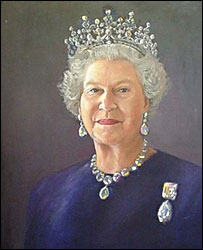 Head and shoulders study of HM The Queen This portrait was in fact unveiled by Her Majesty in March 2000, but despite having met the Queen, Chinwe admits that she was still nervous about the Royal sitting. "Before she came in I had a panic, I didn't know how to curtsey," said Chinwe. "I was standing there in the middle of this room and thinking I'd better practise how to curtsey. [I was] then thinking people will be watching this on the cameras and feeling really stupid! "When she came in she was absolutely fine. She could see I was a little bit nervous and started telling jokes and stories. I just laughed until tears were pouring down my face and when she could see I was relaxed then she stopped and we carried on. "She liked my study of her, which is her head and shoulders… I walked out of Buckingham Palace on air." The black artistEarning a prestigious Royal commission guaranteed Chinwe a high level of press attention, but there was also disappointment. The media's primary focus was on her colour, rather than her art. "The the first point they could pick on was black. If we are that integrated, nothing should be made of the fact that I'm black," she said. "It should be that I'm just an artist – it was something that just started and everybody else picked it up – but once it started it just rolled along. I have not control on what they say. "It showed where society still was as to my colour. It wasn't expected, but it didn't surprise me when it happened. 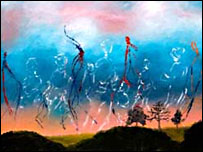 Spirits In The Sky (detail) "I feel that in society... that institutions need to have specific artists and automatically they represent the face of all artists of that colour and once they've done that, if you haven't broken through that’s very difficult. "I can't say that I just go out and my work sells... as it doesn't. I have to work hard to get myself, my work seen. "As for recognition – you may be recognised, but it doesn't put bread on the table - you have to work hard to get the bread." Chinwe feels there is still a need for Black History Month - but not without reservations. "When you have Black History Month you can concentrate the mind on looking at something people don't normally look at – but is it putting black, black history and black people into one slot and that's them over and done with for that year? "The rest of the year is what people would say in inverted commas 'normal' - but black and our history is still normal, we should be part of society, not needed Black History Month to say this is what we are." Black History Month at the SCVAThe Sainsbury Centre's autumn exhibition, Alien Nation, also forms part of Black History Month and explores ideas about racial difference and racial stereo-typing through the language of sci-fi. last updated: 12/10/07 SEE ALSOYou are in: Norfolk > Entertainment > Arts, Film & Culture > Arts & Literature > Interview: Chinwe Chukwuogo-Roy 

Listings Providers
The BBC is not responsible for the content of external websites |
| | About the BBC | Help | Terms of Use | Privacy & Cookies Policy |