| 29 October 2014 |

|
|
| BBC Homepage | | |
| |||
| Contact Us | | |
Coast: FeaturesYou are in: Norfolk > Coast > Coast: Features > Coast: Dredging the North Sea 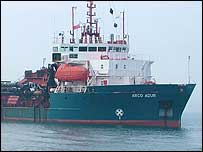 Dredger Arco Adur at work off Norfolk Coast: Dredging the North SeaWhether it's building a child's sandpit or raising a sky-scraper, this work has one thing in common: the need for lots of sand and gravel. Climb aboard the Arco Adur, to find out about one of the Norfolk coast's biggest industries. Britain uses around 68m tonnes of sand and gravel each year and more than a fifth of that comes from the sea bed around the country including a number of sites off the Norfolk coastline. Mammoth dredging ships with 40 metre-long pipes hanging down from the side of the hull, act like oceanic vacuum cleaners, sucking up a mixture of salt water, sand and stones. Tim Butten, the captain of Hanson Aggregate's dredger Arco Adur, explained how his vessel worked to trawl up tonnes of materials. Pointing to a lump of steel on the end of the pipe, "This is called a drag end," he said. "It has a gridded mesh on the base and is on a flexible joint, which allows it to actually sit on the sea bed, and a pump in the middle of this pipe actually sucks everything from the seabed into this pipe. 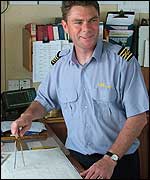 Capt. Butten pin-points where to dredge "It then comes on board and is graded with the stone that we want kept on board. The rest is rejected into the sea again," he added. Specified sitesAs the vessel reaches the extraction site, which is marked out and licensed by the government on behalf of the Crown Estate, the captain and his crew prepare to start loading the sand and gravel. Boatswain Michael Keenaghan, who's worked on dredgers for 15 years, told how the suction pipe is gradually lowered off the side of the ship to the floor of the North Sea. "We'll lift the pipe out of the stowage position," said Michael. "We're talking about 80 tonnes of pipe, hanging on three wires. But it's pretty robust and we can still dredge in conditions of five or six on the Beaufort scale. "Now the pipe is sliding down a groove in the ship's side and will connect with a valve in the side of the ship, and we'll be ready to go." A few whirs of motors and clunks of electromagnetic switches, and the operation's complete. Then the noise of the engines deepens as the pumps start up - and soon white water is flooding out from the loading towers. Work beginsA few seconds later, the head of the dredger hits the sea bed and the water quickly turns brown, as the briney mixture of sand and stones are brought up with the water. Almost as much though is lost overboard as goes into the cargo hold. "We're now loading the cargo over the 10mm screen beds," says Michael. "Anything smaller than 10mm goes back into the sea, while anything bigger than that goes into the hold. " Up on the bridge, Captain Butten is steering the Arco Adur up and down a series of lines super-imposed onto a plan of the licensed extraction area. He says it's vital they stay within the designated zone. "We try to keep to them best we can," he said. "The red lines are a no-go - that's outside of our licence area, so if we go out of that we have to report ourselves to the Crown Estate and explain ourselves. But generally we don't!" Keeping trackWith Global Positioning Satellites, the authorities can easily check up on any illegal activities. Marine dredging is an industry that's heavily regulated, according to Mark Russell, who's the development manager for the British Marine Aggregate Producers' Association. "We're a very highly regulated industry and the reality is if there's any potential threat that our activity could cause coastal erosion, the government would very quickly withdraw our permissions and indeed that ability exists," he said. "There is the facility in the consenting regime to withdraw permission to dredge at any time," added Mark. 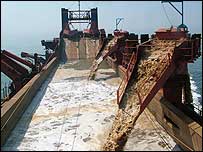 Gravel is sorted through a bed Coastal erosionBut many people in Norfolk who watch the coastline erode refuse to believe what the industry puts forward as evidence, which it claims shows they're not to blame for crumbling cliffs and encroaching waters. Pat Gowen, from campaign group MARINET, a branch of Friends of the Earth, has drawn up a report on what he believes to be the damaging effects of dredging. "If we continue to allow the exploitation of our offshore sand and gravel, particularly at this time of sea rise and worsening climate, now that funding for coastal defence has been reduced and reimbursement for loss refused, we shall soon be faced by a huge loss of our coastline, its productivity, its villages and many inland communities reliant upon marine protection," he said. "We shall also see the final demise of our longshore fishing industry and its associate businesses," he added. Mark Russell refutes these claims: "There is this perception that the sands from the coast, whether it's at Happisburgh or Great Yarmouth, in some way feed the depressions created by marine aggregate extraction and cause them to be filled up: that you create holes, the sea's a naturally mobile environment, therefore those holes must actually fill. That isn't the case," said Mark. "Between the areas that are dredged and the coastline there are quite significant changes in topography, depressions, if you like, deep areas, which aren't filling in and haven't filled in. "The sand would have to travel up sand banks, down sand banks, up slopes. It's completely inconceivable that can happen," he added. Hanson Aggregates is now waiting to hear whether John Prescott's department will grant a new licence to allow two million tonnes of stone and sand to be dredged from one of the extraction areas 25km off Great Yarmouth. Licence due for renewalThe current licence, which has lasted ten years, is due to expire in March. David Harding, a consultant for Hanson, said it's an important site for the company. "It's a site of particularly good sand and gravel," said David. "This is backed up by the government's view that if they have permitted a site they would prefer to see them extracted to extinction rather than permit new sites." "It will certainly put pressure on other resources," he said. "We will have to look at other resources and licences we have around the UK and see if we can fill the gap created by the licence being either rejected or a delayed, by getting resources from other areas. It's as simple as that. "It would put pressure on other areas, and there's no doubt it would have an impact on construction in the south east, as they are so dependent on marine dredged aggregates," added David. Advocates for and against dredging won't easily reconcile their differences, but for places like Winterton and Happisburgh irony strikes as construction isn't the only use for these sea-sourced minerals. Marine-dredged sand and gravel is often used to restore coastlines around the UK - providing sandy beaches for tourists or simply building up what's been washed away by the tides. According to industry figures, around 25 million tonnes have been dredged for this purpose since the 1990s, but to date it's failed to protect some of the most vulnerable parts of Norfolk. last updated: 08/04/2008 at 16:11 You are in: Norfolk > Coast > Coast: Features > Coast: Dredging the North Sea |
| | About the BBC | Help | Terms of Use | Privacy & Cookies Policy |