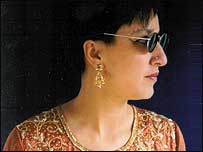
Samia Malik has launched the follow-up to her debut album, The Colour Of The Heart. The Norwich singer's latest CD is called Jaago - Wake Up and features songs in her native language, Urdu. Samia was born in Saudia Arabia but her parents moved back to their homeland of Pakistan when she was a baby before heading to Britain when she was six. She settled in Norfolk with her young son when she came to read maths at the UEA. Around that time she joined a local choir, but later decided she needed to learn how to compose songs and perform in her mother tongue. She was keen to express her experiences in her own voice while keeping her language alive as a British Pakistani living in Norfolk. Years of training with an eminent classical Indian musician, have now brought the 42-year-old to the point where she's released her second album and has just completed a ground-breaking dance-theatre tour of India. The 15-date tour, Colours Of The Heart, was put together by Samia and the controversial Indian dancer and actress Mallika Sarabhai. Together, along with four other performers, they focused on empowering women with stories based on personal experiences which were enacted through music, dance and the spoken word. One of the highlights of the tour was a visit to Kashmir - the first time artists from Pakistan and India have performed together since 1947. However, since the summer tour life has not been any less hectic for the mother of two. She has taken a sabbatical from teaching to take a degree in visual arts at the Norwich School Of Art And Design which has led to her designing the cover of her new album. Samia spoke to us about her new album, her life in Norfolk and how her songs written from the perspective of an Asian woman living in Britain have meaning for everyone. How long have you lived in Norwich? It's 21 years this year. I came here to go to the University of East Anglia. There were practical reasons for settling here - I came here as a single parent. | "The whole idea of Black History Month is about celebrating difference but at the same time being able to be aware of our common humanity." | | Samia Malik |
The reason I chose Norwich above two or three other universities I'd been accepted at is because they had a nursery. It was as simple as that. By the time I'd finished my degree and did my teacher training I was offered a job - and at that time students used to be housed. So for the first time in my life I had my own accommodation that no-one could throw me out of. Before that I'd been homeless in London and had a lot of challenges early on. Also, I was being offered a job at a school [Notre Dame] I really liked. I decided to stay for then, and obviously it's been good enough to stay here because I'm still here 21 years later and I'm still thoroughly enjoying it. How long have you been writing music? When I finished my teacher training I decided I wanted to sing. I'd been singing with what was the Norwich Women's Soul Choir and a lot of my friends sang in it and we did a lot of gigs and had a lot of fun. But I realised it wasn't the kind of singing I wanted to do. I wanted to sing Urdu songs, Asian songs. I'd learnt a different way of singing with the choir because with Western music you have harmony which was very unnatural for me. I had to stop doing this bending and sliding of notes and do this straight, rigid singing. So then I decided I needed a teacher and eventually I found one in London. I became a supply teacher so I could go away regularly and I funded myself. My son was about eight or nine and I would go to London once a month to have a lesson with a very good teacher, Baluji Shrivistav, and he's still very involved in my life. He gave me tuition in classical Indian music: raags [scales which songs are composed from] and taal [rhythm]. For classical singing you have to have an idea of the rhythm and the scale before you can do any compositions. I went to him for six years and then eight years ago I was keen to sing songs which weren't Bollywood songs or ghazals, which are Urdu couplets set to music. I wanted to compose new stuff using what I'd learnt. In 1991 there was a book published called We Sinful Women, edited and translated by a woman I knew. She saw me singing in London and at the end I said, 'If anyone knows any good songs please let me know!' She said, 'Here's this book.'
 | | Samia Malik |
It was full of Urdu poetry but on the other page was the English translation. It was extraordinary for me because I'm bilingual and all of a sudden there was this book of strong feminist poetry being given to me. My first compositions were based on this poetry - that was my first launch into composition. But then I felt it doesn't go far enough. These are Pakistani women - the book was written by Pakistani women in Pakistan, so although the issues were relevant to me it wasn't far enough. I'm from Pakistan but I'm here. There were loads of other things that I wanted to explore about my own experiences. That's when I started songwriting started. My lessons changed then - instead of him giving me another raag or taal to work on I would be saying, 'Here's another song!' You've been described as an international performer, where have you played? I've performed around the UK and I've been on to the continent and I've been for a few years to festivals in Italy. I've just done a major tour of India - quite a controversial tour in some ways because one of the dates was in Kashmir, the occupied Indian-administered Kashmir. It felt great to take a show there called Colours Of The Heart, talking about how we can celebrate differences but also be aware of what it is that unites us, our common humanity. I wanted to ask in whose interests are we being divided as a people - we have so much in common. When we have so much in common why are we always being categorised as: I'm a woman, I'm Asian or I'm white or I'm rich or I'm gay. The whole idea of Black History Month is about celebrating difference but at the same time being able to be aware of our common humanity. To me the answers are clear. As I say in my CD, Jaago - Wake up, there is a new dawn. Things are changing, you just have to ask the right questions. How did the Indian tour come about? I went to see a performance at the UEA by a woman called Mallika Sarabhai. She runs an academy in Gujarat in Western India. She did a show called Sita's Daughters. She's a Bharatnatyam dancer and she came on in her beautiful Indian costume with her beautiful music playing and she did a few steps of something gorgeous, then she stopped, whipped off her wig, threw it to the floor, ripped off her costume and she was wearing a T-shirt and jeans. At that point I thought I want to work with her because that's what I'm doing with my work but I was using a different art form. I didn't have my first CD together but when I did I sent it to her and she said when she put it on, there was that same moment of recognition. I then went to India and worked on this show. The work you did there, was it based on being an Asian woman in British society? Yes, it was. There's a good example of how these things cross over. Again in Jaago there's another lyric which I'd written in England: This is my country, this is my home, why am I made to feel like an outsider when it's my own country, when it's my own home. I went to India and I sang those lyrics and I had the most extraordinary feeling. When I got to India I realised that it's also my home in the same way Pakistan is my home. Pakistan and India were unified until something terrible happened in 1947 but what still unifies them is the language and the culture and the food and the problems. So much is the same. I could stand up and sing, 'My country, my land' and it made as much sense there as it did here. I'm looking forward to singing it in other countries to see if in fact I am a citizen of the world! I was writing something specific about being in England but you see how something very personal can translate. Your performance at the Garage will mark the first public performance of your new CD, are all of the songs in Urdu? No, not all of them. There are 11 songs and out of that two of them are in English and there's another piece which is in English which is a spoken piece. But the translations will be up on the stage and there will be projections which I am working on. Also, there will be some dancers with us to interpret some of the songs. It's not like in India where it was a dance performance - this is a song performance but with the support of the text and live performances. How different is this album from your first, The Colour Of The Heart, does it deal with any different issues? It develops them. In fact it's got a couple of the same songs but different arrangements of them. The first CD was very much a production of what I was doing at the time which was the band I was working with [Garam Masala]. There were four of us - although they were all my songs - there was very much a flavour of each of the other three performers in it and it was a very live sound because that's what I was doing, I was doing a lot of live performances at the time. There was a lot more English and actually a bit of Welsh because of [the singer] Sianed, so there were a lot of songs where I was singing in Urdu and Sianed was singing or speaking in English. This one has got a lot more Urdu in it. I'm still using a lot of Western musicians and it's also being managed by my old teacher, Bhaluji Shrivistav. Because of him I've got wonderful instrumentation and just his knowledge because he is a world class musician and his skill really has made it into a beautiful piece of work. I'm really proud of this. I was proud of the first one but this is more true to me now. That was true to me then, I've moved on as a performer. Garam Masala don't really work together any more - I work either solo or with different musicians or with some of the Garam Masala musicians but we don't tour like we used to and I don't want to tour like we used to because that's done and this is something new. Jaago - Wake Up was released on 29 October 2004. |