Organic?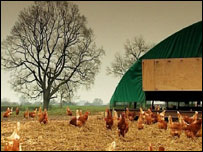 | | Some chickens don't live as good conditions as these |
Do you buy organic because you care about the condition in which your
food is produced? You may be surprised at what you're actually getting for your
money, as Inside Out investigates. Supermarkets are full of organic products,
so-called because they're produced in supposedly better, more sanitary and less
chemically-enhanced conditions. But are they really worth the extra cash? Take
eggs, for example. Many people now only buy free range or organic eggs because
they disagree with battery farming, where chickens are bred in overcrowded factory
conditions to produce cheap eggs. But it seems that some of the £19
million worth of organic eggs sold each year may have come from exactly the same
sort of conditions as battery-farmed produce. To label chicken or eggs as
organic there are certain standards all food producers must meet, like making
sure their birds spend a third of their life outdoors, as well as feeding them
organic grains and making sure no antibiotics are administered unless absolutely
necessary. But the reality is that current regulations mean very few of
the 30 million eggs sold as organic are purely organic. That's because
birds which could go on to produce organic eggs can spend the first 18 weeks of
their lives being fed non-organic food, kept in-doors and given antibiotics. They
can then go on a conversion course to become organic. And some organic chicken
farms are slow to treat an ill bird, because if drugs are used, the farm can lose
its organic status, and that costs. In extreme cases, the reluctance to
medicate can lead to death and disease in the flock. Inside Out reveals
footage shot secretly by animal welfare campaigners at a chicken farm and asked
vet Alastair for his opinion. He was shocked at what he saw, and has this
advice for consumers: "People have an image of organically
reared birds as happy birds, ranging in the field - and in a lot of instances
they are. "I think you can get good and bad farms mo matter what the
production method is, and I think we have to be aware of that, but I don't think
all organically reared chicken is as welfare friendly as it might be or should
be." One of the better examples are poultry farmers Roger
and Adrian Potter, who raise 26,000 organic chickens on their 17-acre Yorkshire
farm. They're committed to being totally organic, as Roger explains: "It's
a lovely way to farm, as natural as you can get, but it's an extremely expensive
way to farm. This is the ultimate system we can get." But for the 26,000
egg-laying hens kept in the spacious mobile farm houses, it's a small price to
pay for a better quality of life and more consumer-friendly end product. Just
make sure next time you go to the supermarket that the food you're buying does
exactly what it says on the tin. Links relating to this story:The
BBC is not responsible for the content of external website | 


 Inside
Out - Yorkshire & Lincolnshire: Monday October 10, 2005
Inside
Out - Yorkshire & Lincolnshire: Monday October 10, 2005