STOWAWAY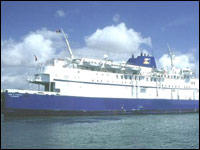 | | Inside Out uncovers security
loopholes in ferry travel |
In today's world of worry and speculation
over terrorism, you expect to undergo more thorough security checks
when travelling. But Inside Out discovers some shocking security loopholes
on the North Sea ferry route from Rotterdam to Hull. Earlier in 2004, Inside Out Yorkshire & Lincolnshire
uncovered security failings at Humberside Airport. Now, it seems there are similar failings on the North
Sea ferry route. Inside Out reveals stowaways are not just a thing from
adventure novels anymore - they are a reality. Getting aboardAround 3,000 people use the ferry route from Hull to
Rotterdam every day, with a similar number travelling to Zeebrugge in
Belgium. The route is popular not just for business travellers,
but also holiday-makers from the north. With so many travellers using the service, added security
measures have been put into place, but as Inside Out discovered, they
are not always implemented. 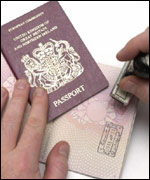 | | Passport checks
should be mandatory when travelling to another country |
An undercover researcher working for Inside Out set out
to discover how easy it would be to stowaway to the UK. He wanted to see if he could board the "Pride of
Hull" ferry in Holland, and enter the UK illegally. Most sailings along the Hull to Rotterdam route are carried
out overnight, so our researcher made his way to the Europort terminal
at around 7pm, expecting tough security onboard. Instead, he was able to pass through security and mingle
for 45 minutes with coach and lorry drivers who had already gone through
their pre-boarding checks. Despite carrying concealed camera equipment, which would
have shown up had he gone through the appropriate security checks, our
researcher snuck through unchallenged. He made his way through an unguarded door and at one
point walked straight past two Dutch Royal Marines who were screening
cars boarding the ferry. And so, the researcher was able to access any areas of
the ship he wanted without so much as a second glance from security officials. A one off?Surely the incident must have been a one off?  | | Morland Sanders
was shocked when he wasn't discovered |
Sadly, it seems not. On the same ferry crossing Inside Out's Morland Sanders
was also able to dodge the system. He passed through Hull security without undergoing any
passport or customs checks. Morland actually spent over an hour hiding in the boot
of a car that was on the ferry. When the car disembarked at Hull it was simply allowed
to drive through the immigration checkpoint. If correct security measures had been in place, Morland
would have been discovered in an instant. Lifting the lidIn October 2003, 24 asylum seekers entered the UK via
Hull's ports in just four days. Eight of the travellers were hidden in a lorry, a further
16 in a shipping container. At the time it was said the smugglers chose Hull due
to increased security elsewhere in the country.  | | Beverley Hughes
was keen to increase security measures at UK ports |
In the wake of the security breach, then Immigration
Minister, Beverley Hughes, ordered tighter security measures be put in
place. It is surprising then, just how easily Inside Out breached
security measures at Hull. We showed the tape to security expert David Jones, who
said flaws in security at Rotterdam had clearly compromised the safety
of the ferry and its passengers. "It's quite serious. It's almost an open invitation
for worse things to happen. "You have got someone present who hasn't been checked
and whose bag hasn't been checked - he could have been anyone from a petty
thief to a terrorist," he warns. Secure forceDodging security systems on the Hull to Rotterdam route
wasn't thanks to sneaky tactics. It was the lack of implementation of procedures that
allowed Inside Out to pass through unchecked. In fact, the technology put in place at various ports
around the country is state of the art. It includes: - Carbon dioxide detection - Guards search lorries
or containers with a CO2 detector, which looks like a ski pole with
a box on it. The detector will highlight the presence of human breath
- Scanners - Scanning machines x-ray the contents of
a container or truck to check for stowaways
- Heartbeat detectors - Hardware that can "hear"
the sound of a heartbeat using seismic sensors
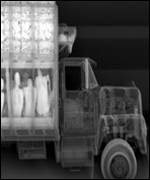 | | Scanners can
detect any humans onboard lorries or vans |
These methods, alongside the searching of all cars and
trucks onboard the ferry and mandatory passport checks for all passengers,
should be keeping us safe. "We are not complacent
We have to ensure we
stay one step ahead of the criminal gangs who traffic people across Europe,"
Beverley Hughes commented in February 2004. But it seems security staff are being complacent
if Inside Out's investigation is anything to go by. The futureWith continual security breaches taking place around
the UK we may be destined to carry identity cards. A pilot scheme was launched in April 2004 where 10,000
volunteers were invited to use the cards, which hold biometric information
such as iris scans, finger prints and facial recognition. The cards are expected to take over from other forms
of ID and supporters say they will make life easier for officials and
security staff by being almost "foolproof". But surely part of the problem is the enforcement of
security devices already in place? As for the security on the North Sea ferry route, only
time will tell whether it improves, but certainly Inside Out's investigation
has highlighted the need for action. | 


