 | Fair
deal - are Polish workers being exploited in Hull? |
Eastern
European exploitation?Since the massive expansion of Europe two
years ago, there's been a huge influx of workers from eastern Europe. In
Hull hundreds of migrant workers are snapping up jobs in the local economy. The
result is cheap labour and cheap food. Inside Out goes back to the beginning
of the migrant trail to find out why some Poles claim that they're being exploited. Recruiting
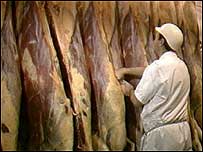
cheap labour The Polish workers in Yorkshire and Lincolnshire
earn four times what they would get in Poland so why are some of them unhappy? "Rich
people here are making money out of foreigners." Paul.
"I'm so
fed up I'm going back to Poland." Adam. | Polish
workers |
Our story begins in Krakow, Poland where we
saw an advert in the local paper for butchers in England. It says that transport
and accommodation will be provided.
Inside Out wanted to investigate
allegations that the jobs and wages which workers are promised in Poland aren't
always delivered when they get to the UK.
John
is a butcher in Hull - he says that he was sent to share a small terrace house
with 13 people, each paying £45 a week rent. "There
were a lot of people there, we had to live two or three people in tiny rooms,
everything was wet, wherever you were everything was damp."
Adam's
experience is no better - his home is a tiny room, barely bigger than his single
bed. He says he can take that but he's quitting over his pay rates.
Adam
speaks only Polish, but his contract was in English. He thought he's signed
up for £9 per hour overtime which he'd been promised back home, but in reality
he is earning much less. "I am disappointed and I am returning to Poland,"
he tells our translator. Both Adam and John were employed
in local meat factories, but were contracted by ITC for an agency called Staffline.
Companies like ITC recruit staff on behalf of several British agencies.
Long working hours? Staffline's
turnover is around £80 million a year, and it's chaired by Derek Mapp, former
head of East Midlands Development Agency. We sent Maciek, a Polish journalist
into its Hull office to apply for casual temporary work.
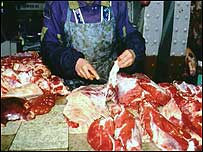 | | Long
hours are often worked by migrant workers |
Maciek speaks little
English and recruits are not encouraged to bring someone to translate. He
was given a pile of forms to fill in, including one committing him to work more
than the European limit of 48 hours per week. Staffline woman offered him
work - six days a week, 12 hours a day - that's 72 hours, way beyond the working
time directive. By the time Maciek signed his contract he'd also been told
he'd be charged for safety equipment, and would have money deducted for the bus
taking him to work.
Maciek's experience is not unusual. Lost
in translation? Mary was employed by Staffline in Hull, recruiting
up to 40 Polish workers a day - she asked us to conceal her ID.
According
to her, Staffline was really busy and didn't have enough staff to do interviews.
Workers were told 'just sign this' - she doesn't know if it was on purpose,
but she does say that staff didn't have time to explains.
Staffline say
they strongly refute any allegations that they mislead workers who dont
understand English. They insist that they dont provide accommodation
to any contractors, instead the accommodation is supplied by reputable letting
agents and of good quality. Staffline say that before workers leave Poland
they are told in Polish what their pay and working hours will be.
They are then asked to sign to say they understand these conditions. Staff
recruited in England are tested for their knowledge of English, and may choose
to opt out of the 48 hour limit. The company says they look after the 3,500
workers on its books and co-operate with licensing authorities and unions
to raise standards.
Workers rights
Not
every agency is bad, but recruitment agencies are not forced to guarantee work,
and are working within the law when they deduct wages to cover workers' accommodation
and transport costs. We meet Hull's honorary Polish Consul, Professor Carby-Hall,
who's also a Professor of International Law. He's investigating this problem
for the Polish government, and has evidence that exploitation of migrant workers
is happening throughout the EU. In some local factories over three quarters
of the workforce is made up of Polish temporary labour, all looking to their religion
for support.
"It's
not right and not moral for people who come from poorer countries to be exploited
by any of the stronger original 15 countries of the EU." | Professor
Carby-Hall |
Hull's Polish community are avid churchgoers
- over 4,000 new parishioners have turned up in the local Catholic churches over
the last two years. A church-led organisation, "Hull Together"
has called in the trade unions to help advise the workers. Professor Carby-Hall
believes that the treatment of migrant workers will be an important issue for
the future: "It's not right and not moral for people who
come from poorer countries to be exploited by any of the stronger original 15
countries of the EU."
But for some Poles their dreams
and hopes have already been shattered. Read
your comments in English and Polish Links relating to
this story: The
BBC is not responsible for the content of external websites | 


 Inside
Out - Yorkshire & Lincolnshire: Monday November 13, 2006
Inside
Out - Yorkshire & Lincolnshire: Monday November 13, 2006