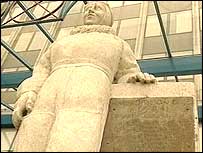
AMY
JOHNSONAmy
Johnson’s daredevil flying exploits made her an icon of her age.
But
her glamorous life and career tragically ended in a mysterious plane
crash in 1941. Sixty
years on, Inside Out lays bare the elaborate rumours surrounding
her death. Here
we examine the most likely scenario of what really happened to a
homegrown heroine. Tragic
journeyAmy
Johnson flew into the spotlight when she became the first woman
to fly solo from England to Australia in 1930. On
January 5 1941, Amy Johnson took off alone in thick, freezing fog
from Blackpool airport. She
was delivering a plane to Kidlington airbase in Oxfordshire - a
simple, 90 minute flight. | Amy's life | - 1929
- Johnson receives her pilot's 'A' license in July 1929. She
became the first woman in England to be granted an Air Ministry's
ground-engineer license in December 1929.
- 1930
- Became
the first woman to fly solo from England to Australia. Johnson touched down in Darwin on May 24 1930. Her
8,600 mile flight took 19.5 days in her aircraft named Jason. According
to reports, she had previously had only 75 hours of flying
time experience. The Daily Mail awarded her £10,000 - a record paid for
a feat of daring. Johnson
was awarded the C.B.E. From King George.
- 1931
- Johnson
married fellow British Aviator James Mollison They later divorced. She became
the first pilot to fly from London to Moscow in one day. Flying
in Jason II, Johnson made the 1,760 mile journey in 21 hours.
- 1932
- Broke
the record speed for the London to Cape Town flight by 11
hours. The record was set earlier by her husband.
- 1933
- Johnson
and Mollison flew across the Atlantic together but crashed
on landing at Bridgeport, Connecticut. Both suffered minor injuries.
- 1936
- Regained
the London to Cape Town record which she set in 1932. This
had been surpassed by Flight Lieutenant Tommy Rose. This
was her last long distance flight.
- 1940
- Johnson
joined the Air Transport Auxiliary to help the wartime effort. According
to the Royal Air Force History website, she received a then
huge salary of £6 per week.
- 1941
- Fatally crashed whilst on a routine RAF mission delivering
an Airspeed Oxford aeroplane on January 5 1941. Her
aircraft plummeted into the Thames Estuary. Her body was never
found.
|
Four
and a half inexplicable hours later, Amy’s plane ditched in the
Thames estuary - 100 miles off course. A dramatic
rescue attempt followed, as the HMS Haslemere set out to rescue
survivors. Unfortunately, they were unsuccessful. RumoursMuch
hearsay surrounds the crash .. Some
say Amy was involved in the seedy unofficial business of flying
a spy out of the country. Rumour has it that this could be a
German lover. Some
reckon Amy was shot down by British anti-aircraft guns. Others
have claimed that German planes could have taken her down. Others
said the crash was an elaborate plan to fake her own death. None
of the above rumours have ever been proved. It
is largely accepted that the crash itself occurred due to bad weather
and risky judgment. Key
witnessFor
the first time in 60 years, a key witness tells his story to Inside
Out. Derek
Roberts, a clerk in the RAF flight office on the Thames, claims
"A parachutist had come down in the water." His
friend, Cpl Bill Hall (RAF) was on board the HMS Haslemere.
When
Amy Johnson's plane ditched in the Thames on Jan 5 1941, the crew
of the HMS Haslemere spotted her parachute coming down and set out
to rescue her. Cpl
Bill Hall then returned and submitted a report about what he had
seen and heard during the attempted rescue. Derek typed that report up, and
listened as Cpl Hall told his story. Derek's
storyDerek
told Inside Out, "He came in to report what had happened, and I
took down what he said." "I
typed the report and he approved it, and I put it to the flight
commander." "He
came in with the crew that were landing and he was a bit shaken." "He
said that while he was on deck, a parachutist had come down in the
water and had drifted near the Haslemere." "She
called out that she was Amy Johnson, that the water was bitterly
cold, and could they get her out as soon as possible." "They
threw her a rope, but she couldn't get hold of it." "Then
someone dashed up to the bridge and reversed the ship's engines,
as a result of which, she was drawn into the propellor and chopped
to pieces." "Later
on in life he used to say to his neighbours that there had been
an official cover-up over Amy's death. That for some reason it had
all been kept quiet."
The
crew of the HMS Haslemere claimed they saw two bodies floating in
the Thames estuary - even though Amy had set off alone. 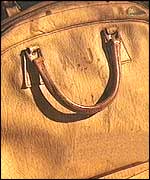 | | Was
this bag Amy's secret companion? |
The
existence of a second person was never established, fuelling the
spy rumours. Author
of a soon-to-be published biography of Amy Johnson, Midge Gillies,
believes the mysterious Mr X is easy to explain. "Amy’s
pigskin bag, fished out of the Thames after she crashed could be
Mr X." "In
fog and sleet it would have been easy to mistake the bag for a head
and shoulders floating in the water."
Hero
The
Halsemere's Captain, Lieutenant Commander Fletcher dived into the
icy waters during the rescue. He
was brought out the water unconscious and died later of hypothermia
without ever telling of what or who he saw. Without
his account and a lack of further witnesses, it is likely that exact
details of Amy Johnson's death will remain an eternal mystery. Despite
the questions surrounding her death, Amy remains an inspiration to many woman.
Her
legacy lives on in Hull where her statue still stands proud in the
city centre | 


 Inside Out - Yorkshire & Lincolnshire: Monday 21st October, 2002