Sussex
follies and Mad Jack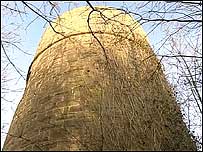 | | Mad Jack's magical tower in the middle of a field |
Inside
Out looks at some unusual features on the Sussex landscape, and asks if their
creator John Fuller was mad or just slightly eccentric? A pyramid isn't
what you'd normally expect to see in an English graveyard. But this pyramid
isn't in Egypt - it's in Brightling, East Sussex. It's not the tomb of
an Egyptian pharaoh, it's the tomb of a Georgian squire - Mad Jack Fuller. The
real Mad Jack
So who was the real Jack Fuller? Born John Fuller
in 1757, Mad Jack was MP for Lewes and incredibly rich. He got his nickname
from the way he spent his money, trying to make sure he was remembered. Today
he is remembered, as 'Mad' Jack. But how mad was he? To find out, Inside
Out has assembled a team of experts: - Keith Leech - member of Mad Jack's
Morris Dancers.
- Celia Caulkin - leads walks around Mad Jack's
follies.
- Geoff Hutchinson - he's written a book about Mad Jack.
Sugar
Loaf So was Mad Jack actually mad? Let's look at the evidence! Keith
Leech says that Mad Jack was a very keen gambler. 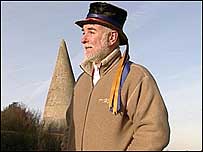 | | Keith Leech stands by Mad Jack's Sugar Loaf |
He
had a bet that he could see Dallington Church spire from his house. When he got
home, he discovered that he couldn't. Rather than losing the bet, he built
the Sugar Loaf. In Mad Jack's day days sugar used to come in conical shaped
containers, hence the nickname.
The important thing about the folly was
what it looked like from Jack's house, a mile or so away. From the horizon,
the Sugar Loaf looks like the spire of a church. It must have cost Jack
a small fortune, much more than he would have won on the bet. Conservationist
Bodiam Castle is an East Sussex landmark, one of the most beautiful castles
in the world. But in Mad Jack's day the castle was in a terrible state,
and it was on the verge of being demolished. The castle's owner was Sir
Godfrey Webster. Unlike Fuller he wasn't a rich man. 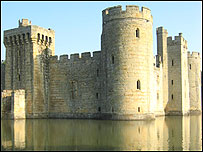 | | Bodiam - the castle that Mad Jack saved |
Sir
Godfrey simply didn't have the money to maintain the castle.
The damage
that had been done to it in the civil war had never been repaired, and the whole
building was gradually falling into ruin. So Sir Godfrey decided to auction
the castle. A group of builders from Hastings builders were the favourites
to buy it, and demolish it to use the stone from the castle to repair local roads. The
builders would have got away with it too if it hadn't been for Jack Fuller. Documents
show that Jack stepped in and bought the castle, for £3,000, and saved it
from the demolition team. "Whenever I visit Bodiam Castle
I always tip my hat to Mad Jack. Subsequent owners of the castle did a huge amount
to restore it to the wonderful attraction it is today. But if it hadn't
been for Jack Fuller there wouldn't have been a castle here at all." Geoff
Hutchinson.
Tower of dreams Another of Jack's
magical projects was a strange tower which looks like something from a magical
kingdom. Nobody knows exactly why Mad Jack built his tower surrounded by
trees in the middle of a field. Celia Caulkin says that some people say
he built it so he could signal to Bodiam Castle. But in reality you can't
even see Bodiam from here. Maybe he just built if for a bit of fun? Job
creator Another surviving example of Jack's buildings is a wall extending
right the way round Fuller's estate at Brightling Park. Mad Jack had it
built around 1816. The wall is six feet high and it extends for four miles. Today
the wall looks a bit excessive but there was a good ulterior motive for it.
Following the Napoleonic wars there was no employment. So Fuller built a wall
around the estate to provide much needed employment at a critical time. "This
was an act of philanthropy, not insanity," says Geoff Hutchinson. There
was clearly method in Jack's act of madness. The Obelisk One
of Mad Jacks' more bizarre creations is The Obelisk, an impressive folly with
no apparent reason behind it. "Whenever I bring people here, they always
ask, why did Fuller build this?", says Celia Caulkin. "It does
look like it's been put up for a reason doesn't it? But it has no inscription
on it and Fuller left no explanation for why it was built here." This
is the frustrating thing about Fuller. Just when you've decided he was mad, he
does something sane. And just when you think he's a rational, sensible
man, he goes and builds a 65 foot tall needle with no point. Life saver In
the early 1800's the stretch of coast near Eastbourne was notorious for shipwrecks In
February 1822, Jack Fuller looked out to sea and to his horror he saw a vast 1,500
ton ship which had run aground. On that day he decided that what this place
needed was a lighthouse so Jack built the Belle Toute. Sadly his wooden
lighthouse no longer exists. The second Belle Toute we see today was built on
the same location, close to the cliff edge. The lighthouse was just
one example of Jack Fuller's desire to share his wealth and do something to help
others. But despite the good intentions his lighthouse didn't work very
well. Up on the cliff top, it couldn't be seen by ships in the mist.
So we've seen the evidence, now we need a verdict. Mad or not mad? What does our
panel of experts think? "Mad. Definitely mad. I don't
think we could call ourselves Mildly Eccentric Jack's Morris." Keith Leech. "Oh
no. Not mad. A colourful, fascinating, eccentric."
Celia Caulkin. "Child
of the times. A typical Georgian squire. Larger than life, very generous, very
eccentric. And totally sane." Geoff Hutchinson. So our
panel has decided by two to one, that Mad Jack was actually sane. But perhaps
he wouldn't mind what we call him, as long as we remember him.
.
He'd probably
he'd just be very pleased, lying there under that pyramid, to know that more than
170 years after his death, people are still making a song and dance about him. Links
relating to this story:The BBC is not responsible for the
content of external websites | 


 Inside
Out - South: Monday February 13, 2006
Inside
Out - South: Monday February 13, 2006