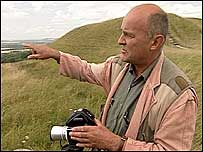
Air
speed record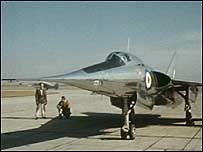 | | Speed
sensation - Peter Twiss' record breaking plane |
Inside Out
looks at the remarkable story of how a British man broke the air speed record
50 years ago. When you think of air speed records and pilots, names like
Chuck Yeager spring to mind, but the south of England has its own hero - Peter
Twiss. Twiss was one of the finest pilots of his generation. Inside
Out tells the story of the memorable day in 1956 when Twiss broke one of flying's
most sought-after records. Record breakers On Saturday March
10, 1956, time was running out for a determined British pilot and the small Fairey
team. They were trying to smash the air speed record, flying from their
base at Boscombe Down in Wiltshire. Peter Twiss, flying the Fairey Delta
Two, had had six attempts at the record "travelling up and down the South
Coast like a bus" as he put it. On each of the flights, at least one
factor in the complex battery of measurements needed to prove the record had failed.
He was going for one last try. Revolutionary plane The plane
was ahead of its time. One of its features would later influence Concorde's
extraordinary looks - because the way the plane landed, nose pointed skyward,
meant the pilot flying blind. The project designer was Howard Colliver: "From
the cockpit forward, it was decided the nose would be drooped on landing - allowing
the pilot to see. That went on to Concorde."
The Americans
were the current record holders with a speed of 822mph. The small British
team were committed to secrecy. If news of their attempts leaked out, they
were concerned the Americans could pip them to the post.
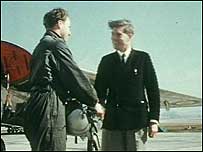 | | Man
with a mission - Peter Twiss takes to the skies |
Yet they could
hardly hide the sight of an unusual Delta winged aircraft hurtling through clear
blue skies - or the sound of the sonic boom as it went through the sound barrier. Greenhouse
owners across the south were agitated as the boom broke glass windows. One
market gardener even threatened to sue the pilot for £16,000. The
Portsmouth Evening News came near to a world scoop that Saturday when it reported
sightings of the plane, the sonic boom and the angry greenhouse owners. But
it didn't go as far as guessing the record attempt. Amazing skill What
pilot Peter Twiss had to do required astonishing skill. Taking off from
Boscombe, he climbed south over Bournemouth and then accelerated eastwards to
Point C near Chichester, the start of the course. | A BRIEF HISTORY OF AIR SPEED RECORDS | |
1906 - Pilot Alberto Santos-Dumont breaks 25.65mph in France.
1912
- Jules Vedrines breaks the 100mph mark.
1931 - George H. Stainforth
makes his mark at 407.49mph
1945 - First jet-engined record by H.J. Wilson
over Herne Bay at 606.38mph.
1955 - Horace Hanes sets first supersonic
record - 822.13mph - at altitude. 1956 - Peter Twiss breaks 1,132.13mph
in Chichester. He holds the record till December 1957 when US pilot Adrian Drew
hits 1,207.63mph.
2004 - NASA's X-43A hypersonic aircraft breaks record
at seven times the speed of sound - 4,780mph. |
At that
point he had to be directly over the huge camera which would snap the plane and
start the timing process.
Then, in completely level flight, he had to
keep his plane on course to Point D near Ford, where the second camera waited.
He was 38,000 feet up and flying at over a thousand miles an hour. It
was like finding two tiny invisible gates in the sky. According to Cyril
Witts, then Chief Radio Operator for the Fairey Aviation company, he had radar
guidance and radio contact with the ground but nothing sophisticated in the cockpit
to help him, "only a map, and a Mark One eyeball". More difficult
still was flying at these speeds with the reheat or afterburner on, meaning heavy
fuel consumption. "When the reheat was on, you could see the fuel
gauge visibly dropping," says Peter Twiss. After doing the course,
he sometimes landed with as little as 10 gallons of fuel left. Daring
flight A little after 11am on 10 March 1955, Peter took off for his
final run. Half an hour later, he was back - having flown the fastest course
yet. His cockpit instruments said it was well over 1,000 miles an hour
- but one of the cameras on the ground had failed to capture the vital moment.
The team was deflated.
Norman Parker was one of the ground crew.
"We just put the plane to bed and went home," he recalls. The
next morning, however, scientists at Farnborough had gone through the critical
photographs and ground timings - and confirmed the record breaking run - 1,132mph.
That week, the press went mad and the team was front page news. The
British had taken on the world and won.
"I think the Americans were
surprised," says Peter, laconically. Speed king Peter
Twiss later swapped planes for boats in a career change that saw him appearing
in several cameo roles in the movies. 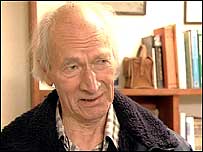 | | King
of speed and thrills - Peter Twiss today |
He joined Fairey
Marine in 1960 and was responsible for the development and sales of its day-cruisers.
Peter appeared in the Bond movie From Russia with Love, driving one of
the the company's speedboats.
He also appeared in the film Sink the Bismark
in which he flew a Fairey Swordfish.
Today Twiss still flies but takes
things at a gentler pace - he's a member of Lasham Gliding Society.
Links
relating to this story:The
BBC is not responsible for the content of external websites | 


 Inside
Out - South: Monday February 20, 2006
Inside
Out - South: Monday February 20, 2006