HIGHLIGHTS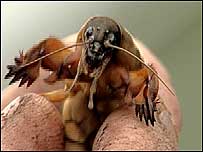 | | Back from the dead - the Mole Cricket lives! |
Inside
Out investigates the English village in dispute over a mobile home park, the ancient
yews of Sussex, and the Mole Cricket rediscovered in Oxfordshire.
Village united Inside Out investigates a quintessentially
English village where wealthy residents have been stirred into direct action in
defence of a local mobile home park. Wealthy residents living in the Oxfordshire
village are protecting their neighbours on a mobile home park from harassment
and intimidation. 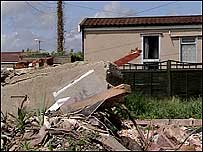 | | Mobile homes - subject of controversy in Oxfordshire |
Sixty women from Blewbury are on call in case there are any problems
at Ladycroft Mobile Home Park. Whenever trouble breaks out, they walk down
to the park to act as silent witnesses. The park residents say they are
being intimidated by site owner Maurice Sines, who wants to buy their homes so
that he can redevelop the park. Mr Sines, who has already bought and demolished
almost half the homes, denies threatening the residents. Return of the
mole cricket Presenter Chris Packham rediscovers a species long thought
extinct. Chris makes history for southern England when he discovers a breeding
colony of a species thought to be extinct in Britain. Whats more
it happens on his birthday. As far as Chris is concerned, its the best birthday
present ever. In simple terms Mole Crickets Gryllotalpa, gryllotalpa, are
spectacular insects. However, few have enjoyed real life views in the UK
as the animal has always been rare and sporadic in its appearances. Thus,
it is only infrequently encountered and necessarily specially protected (Wildlife
and Countryside Act, 1981).
In April 2005 an Oxfordshire man contacted
presenter Chris Packham. The man had previously watched a programme where Chris
had investigated a sighting but failed to find any animals.
| "Reports of the Mole Cricket are always exciting and
especially so when more than one is found." | | Bryan
Pinchen, English Nature |
Exercising his lifelong curiosity
for all things creeping and crawling, Chris investigated further on the off chance
that the insect reported was still present and indeed a Mole Cricket.
After a cursory investigation of a large compost heap, an adult Mole Cricket was
found! Chris immediately took a tape of the cricket to Natural History
Museum in London.
Dr George Beccaloni, Curator of Orthopteroid insects,
was excited enough to visit the site the very same day. Accompanied by
Bryan Pinchen, co-ordinator of English Nature's Mole Cricket Working Group, they
found a total of eight specimens - four male four female including one that was
carrying a spermatophore.
George says, "'It was very exciting to
see eight adult Mole Crickets in one small area because this is the first time
in over 45 years that more than one has been found in the same place".
"We believe that most or all of the mole crickets found during this
period were accidentally introduced into the country in potted plants and other
goods. | MOLE CRICKETS | |
Key features:
Large, robust, and noisy. Specialised in their
adaptations to a subterranean lifestyle.
Highly distinctive. Characterised
by large, powerful forelegs which are used for digging burrows.
The Crickets
are covered in tiny hairs, giving them a velvety appearance. Brown in colour. Usually
grow to a length of about 40 millimetres. They live in burrows which they
extend to form temporary feeding galleries.
Mostly feeds on plant roots. |
"I could tell that one of the females had recently mated. If these
individuals are not native this could be the first time that foreign Mole Crickets
have attempted to breed in Britain. "With 28 million specimens, the
Natural History Museum has one of the world's most important entomology collections
in the world. But we have only 16 British mole cricket specimens, which
shows how rare they are."
"However, most recent records can
all be linked to originating from imported container grown garden trees and shrubs,
or soil sourced from Europe. "Being a subterranean insect with a requirement
for moist, well-drained soil and a source of food in the form of, amongst other
things, roots, container grown plants provide and ideal short term habitat for
the species. "It raises the question of whether the Mole Cricket has
ever really been native, or has only ever been present as a result of importation."
Five other Mole Crickets have been found in Britain this year, all however
are known to have come in as singletons on imported plants. Current thinking
on the Oxfordshire animals is that the eggs or small larvae may have been imported
in soil accompanying the transport of live worms as this is the business of the
man in whose gardens they were found. Under licence Bryan took some of
the crickets found to Bristol Zoo which run the native breeding programme. Note
- It is important to stress that should anyone suspect that they have found a
Mole Cricket, they do not willingly disturb it or its habitat themselves. These
animals are specially protected and consequently any sighting should be reported
to Bryan Pinchen via the Natural History Museum.
The South's prehistoric
landscapes 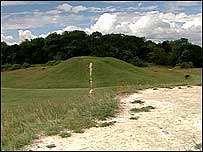 | | Prehistoric journey - Kingley Vale and its ancient yew forest |
Inside Out begins a journey through southern Englands prehistoric
landscapes with a visit to Europes finest yew forest at Kingley Vale in
Sussex. Legend has it that Kings are buried in the nearby bronze age burial
mounds and that the ghost of Tennyson, who often visited the ancient yew trees,
still wanders through the woods. Over the next few weeks the programme
will be visiting places such as The Ridgeway, Danebury Hillfort and Avebury. -
| 


 Inside
Out - South: Monday September 5, 2005
Inside
Out - South: Monday September 5, 2005