WILD BOARS IN THE
SOUTH
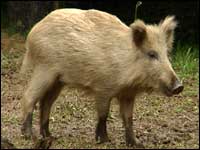 |
| The south is the only place in Britain
that is home to wild boar |
Take a walk through woodland in
southern England and you could be in for a big surprise - one weighing
up to 150 kilos in fact! For the south is the only area in Britain
where wild boar can be seen. Chris Packham goes on the trail of these
elusive animals.
Wild boar are native
to Britain but are believed to have became extinct around the end of the
thirteenth century due to overhunting and the clearing of woodland.
However animals that escaped from farms are now thriving
in areas of Sussex, Kent and Dorset.
To track these secretive animals Inside Out has sought
the help of two of the country's top experts.
Shy and retiring
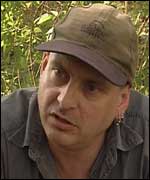 |
| Dr
Martin Goulding has written the first book on wild boar in Britain
and Inside Out is giving you the chance to win a copy |
Scientist Dr Martin Goulding has studied wild boar in
the south for six years and is the author of the first book on wild boar
in Britain.
Wild boar have a fearsome reputation but Dr Goulding says
this is largely unfounded.
"They're very shy, retiring animals and they don't
like disturbance," explains Dr Goulding.
"They'll run away from human contact and they know
we're in the woods before we know they're about."
Inside Out's search begins in a remote block of Sussex
woodland where Dr Goulding shows Chris typical signs of wild boar including
tracks, rubbing posts, wallows and large arch shaped holes in woodland
fences.
Even after six years Dr Goulding remains fascinated by
them and says from a distance the fully gown males resemble small buffalo.
"They're very charismatic and steeped in history,
legends and folklore," says Dr Goulding.
"They've been around in this country up until the
last 700 years and are prominent in heraldic signs and celtic mythology."
Life's a boar
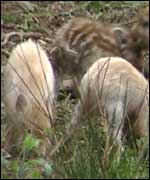 |
| Sows
guard each others piglets allowing the mother time to feed |
They have an interesting lifestyle too.
Largely nocturnal, they live in small highly organised
social groups with individuals playing the role of teachers, guards and
scouts.
Female wild boar, called sows, build nests in dense woodland
in which they give birth. The cute looking striped piglets remain in the
nest for at least two weeks.
When the sow rejoins the group other sows take turns to
guard her piglets while she feeds.
To obtain pictures of boar in the wild, Inside Out turns
to naturalist Derek Harman, one of the first people to film them in Sussex.
He puts food down at the same spot for weeks to attract
the boar to our cameras.
It allows Inside Out to get the first professional pictures
of these secretive animals at such close quarters.
Born to be wild
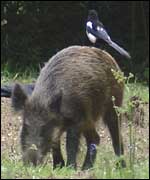 |
| Derek
Harman helped Inside Out get unique images of these animals in the
wild |
Derek admits that at first he wasn't pleased to discover
that boar were roaming free in Sussex as he thought they'd pose a threat
to farmers' crops.
Now he's appalled that some poachers and farmers are trapping
or shooting sows even when they are pregnant or have young.
He believes they should be granted legal protection in
the form of a closed season when it would be illegal to trap or shoot
them.
After years watching and filming them they have won his
respect.
"The fact that everyone's hand was turned against
them but they're still thriving and spreading; it must say something about
their capabilities and their right to live with the rest of us,"
says Derek. |



