ROCK POOLS
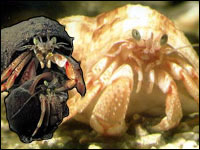 |
| Hermit crabs have an intriguing life
cycle |
If
you thought rock pooling was a pastime only enjoyed by children,
think again. Inside Out joins Marine Biologist Lisa Browning as
she explores the diverse marine life in the rock pools of Kimmeridge
Bay in Dorset.
As the tide
recedes, not all of the coast is left behind dry and with a keen eye and
a bit of patience, rock pools can reveal a wealth of sea life.
Rock pools
offer better survival chances for animals and plants that need to be submerged
all the time.
Deep rock pools provide shelter from waves, allowing fragile organisms
to live on an otherwise exposed rocky shore.
Rock pools
however are not always a safe haven.
Hidden
danger
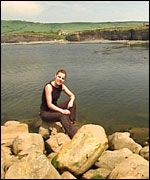 |
| Marine
Biologist, Lisa Browning explores the hidden wonders of rock pools |
Snails that
are able to survive in between high and low tide may find shelter in a
rock pool - but so do their predators!
Large fish may find the rock pools too small, lacking oxygen for breathing.
Rock pools
may also collect unwanted fresh water during rain storms. This is worse
for shallow rock pools high up the shore where organisms must wait longer
for the tide to return.
There may
be hidden dangers in rock pools, but for sea creatures in need of water,
they are vital for survival.
Magical
world revealed
Rock pools provide a life-line for sea creatures and a
unique opportunity to observe them without having to get your feet wet!
| HERMIT CRAB FACT
FILE |
|
Hermit
crabs are crustaceans (crusty-shelled animals that live in the sea)
Hermit
crabs have a soft abdomen and they need to protect this soft part
with an empty snail shell. As they grow, they have to search out
larger snail shells
The
two claws of hermit crabs are different sizes. Each species of hermit
crab has the largest claw on the right or left
Most
hermit crabs live in the sea, but there are a few species that spend
almost the whole of their life on land
Land
hermit crabs must return to the sea to breed. The female crab discharges
her eggs into the sea. Larvae develop in the sea before they change
into miniature hermit crabs, find a shell to protect them, and clamber
out on to the land
Hermit
crabs, like all crustaceans and insects, must shell their exoskeleton
(the armoured covering their claws and front part of their body)
in order to grow. The new larger exoskeleton grows underneath and
needs to time to harden and protect them. This process is called
"moulting"
|
When the
tide goes out rock pools reveal a magical world of plants and animals.
Although
only a stone's throw from dry land these pools are home to creatures from
a different world. But to study them at close quaters - the answer may
lie a little closer to home.
Dorset Wildlife Trust has discovered a revolutionary way of recycling
detergent tablet nets to benefit eco-friendly crabbing.
The charity
is appealing for people to send in detergent tablet nets to be used at
the DWT Purbeck Marine Wildlife Reserve, at Kimmeridge Bay, enabling young
children to enjoy crabbing during the summer.
The rock
pools are bustling with crabs. You could spot the nimble shore crab, the
hairy crab or the delicate porcelain crab and of course the hermit crab
famous for stealing a shell for it's home.
"It
is intriguing to see how effectively detergent nets can catch crabs, syas
Dan Williams, Dorset Wildlife Trust Marine Warden.
The net is
used to replace the hook, which as Dan explains, is good news for all.
"Bait
is put into the net which the crab then grips with its claws. When a hook
is used, fish can accidentally be caught and unnecessarily harmed.
"The hook can also be lost and injure other creatures, such as swans,
as well as people's fingers!"
Home sweet
home
Many small fishes use the rock pool as a shelter against the low tide.
As
soon as the new tide moves in, they leave the pool to wander around much
larger territories where they find their daily food.
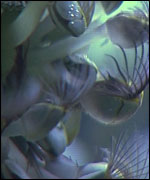 |
| Goose
barnacles were once thought to be young geese waiting to hatch |
Research
has shown that most of these small fishes stay in the same pool all their
lives.
It is not
only fish that make rock pools their home.
Worms of
all shapes and sizes creep along the sea bed.
The candy
striped flatworm is propelled by thousands of tiny hairs on its underside.
Goose Barnacles were once thought to be young geese waiting to hatch.
In the middle Ages the Goose Barnacle was therefore classed as fish rather
than fowl and could be eaten on Friday!
Rock pools are home to a wealth of interesting and diverse sea life and
provides adults and children alike the unique opportunity to study it
at close quaters.
But be warned
- the best sort of rock pooling means leaving no trace of your visit.
Always return creatures back to the sea and leave the wonders of the rock
pool for all to enjoy. |



