Otter
photo gallery | 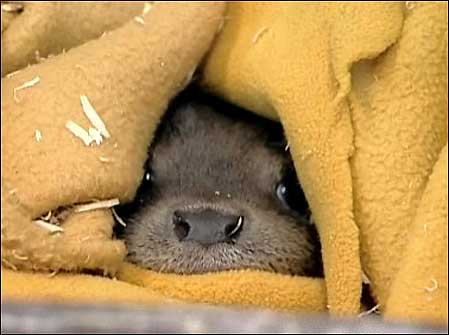 | "I
love the smell of otter in the morning..."
Chris Packham | On
the trail of the elusive Otter. Photo - PA Images. | |
OttersOtters
are elusive creatures that are hard to spot even if you're an expert. You
can sit for hours waiting patiently for these shy animals to emerge, and it's
even harder to see one during daylight hours. There's relatively few of
these remarkable creatures in Hampshire so Inside Out's Chris Packham set out
to track some down. He also discovered how scientists are using DNA fingerprinting
to discover how Otters are returning to our rivers. Hunting for Otter
poo It's hard to spot an Otter - so conservationists have come up with
a great way of tracking the animals using spraint or poo. Every spraint
contains the animal's unique DNA code. In the same way that DNA fingerprinting
identifies criminals, Otters can now be tracked even if they can't be seen. Volunteers
from the Hampshire Wildlife Trust have been collecting samples of Otter spraint
- scientists need a lot of samples if they're going to find enough information.
 | | Searching
for Otter spraint to track these elusive animals |
Graham Roberts
from Hampshire Wildlife Trust explains the importance of getting up early to track
the Otters: "If we don't get here early, the actual droppings
or spraint deteriorate. "The minute it starts warming up, the bacteria
in the Otter poo basically destroys the DNA so it's really important to get here
early."
The spraint contains traces of everything the
Otter has eaten. As well as its DNA, there's the DNA of all the Otter's
food. All of this information gives valuable clues to where the Otters
live and what their habits are. The urban visitor
Otters
don't just live in remote habitats - they also pass through urban areas on their
way to estuaries and other waterways. At Winchester City Mill the Otters
have found a way to avoid humans - they just travel straight under the Mill itself.
Using an infra red camera, we stake out the Mill to film the Otters. 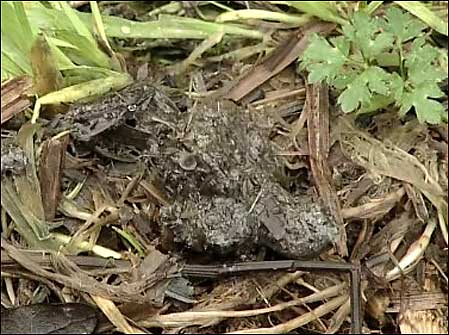 | | This
tunnel under a road is an Otter route, a wildlife corridor |
It
would have been the first time anyone had ever seen them in person there. We
weren't lucky that night, but wildlife volunteers father and son, Chris and Robin
D'Arcy, have managed to catch them on a remote camera in the past. DNA evidence
suggests that Otters can travel large distances and that new animals are coming
into Hampshire to breed, which should ensure that our tiny population survives.
The
Environment Agency is funding the work in the hope of uncovering more secrets
about these animals It is also paying to protect some businesses from Otters
- commercial fishing lakes are rather like free supermarkets to these creatures.
Protective fencing for those areas is becoming essential, another sign that
our Otters are back. Rescued OttersThe New Forest Otter Centre
is a haven for rescued otters - new arrivals turn up regularly because of the
increase in the wild population. Some of the Otters at the centre are too
used to humans to be released, but others remain fiercely independent and can
be let back into the wilds. The DNA studies suggest there may still only
be four adult otters in Hampshire, so rescue centres like this are crucial in
keeping the Otter population healthy. But it's going to be sometime before
we can tell whether Hampshire's Otter population is increasing dramatically. Links
relating to this story:The
BBC is not responsible for the content of external websites | 


 Inside
Out - South: Friday February 2, 2007
Inside
Out - South: Friday February 2, 2007