SOLICITOR'S
MALPRACTICE EXPOSED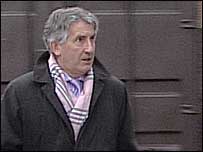 | | Probing investigation - Lancaster was exposed by BBC Inside
Out |
We reveal how David Lancaster, a senior defence solicitor,
was sentenced to three years in prison following a BBC Inside Out undercover investigation.
Inside Out secretly filmed Lancaster helping a client to fabricate
lies to tell in court. When Lancaster was confronted by the BBC with the
results of the investigation, he said that he had done nothing wrong. As
a result of Inside Out's secret filming, David Lancaster was convicted of attempting
to incite an undercover reporter to pervert the course of justice. During
the court hearing Judge Graham Cottle said that the former Warner, Goodman and
Streat partner had broken " every rule in the book". The judge
also said that Lancaster had given "a breathtaking display of unprofessional
conduct". The sting Inside
Out began its investigation in 2004 when an undercover journalist went to ask
David Lancaster for legal advice. 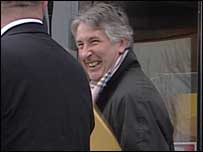 | | Undercover evidence - Inside Out's sting was a success |
Our researcher's cover story was that he had been arrested for supplying
cocaine. David Lancaster gave our undercover client advice on how to persuade
the main witness in his case not to give evidence against him.
Inside
Out presenter Chris Packham recalls the scenario: "Our
researcher told the solicitor that he had sold the drugs. "Despite
this admission, Mr Lancaster went on to invent stories which would explain away
the incriminating evidence.
"He also suggested that the researcher's
friends should visit a prosecution witness to persuade him to change his story."
The
Portsmouth-based solicitor was a partner with Warner Goodman and Streat, and was
subsequently sacked following the BBC allegations.
Erroneous
stories
During the secretly filmed interview, the BBC researcher
said that the police had taken some of his cash for forensic tests. He
told Mr Lancaster this could be incriminating, as the bank notes might have the
drug buyer's fingerprints on them.
Mr Lancaster said that he had come
up with an innocent reason to explain the fingerprints. 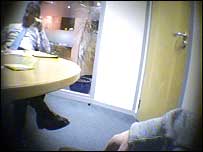 | | "If his prints are on them, it can't be as woolly as
'I loaned the money'. That sounds so limp-wristed and crap that a jury would say
'I don't believe that'." | | David Lancaster |
The researcher suggested he might have owed the money, but this explanation
was dismissed by the solicitor.
Mr Lancaster said, "If his prints
are on them, it can't be as woolly as 'I loaned the money'.
"That
sounds so limp-wristed and crap that a jury would say 'I don't believe that'."
The solicitor then went on to suggest an alternative story to tell in
court: "You can say that you had a £50 note that
you asked him to change."
Mr Lancaster, 54, also had an
explanation for why the researcher's fingerprints might be on the wrap of cocaine:
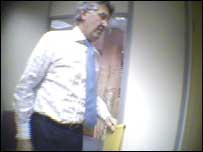 | | Warner Goodman and Streat disassociated themselves from Lancaster |
"You could say that at the time he changed the 50 quid for me,
he showed me this cocaine wrap and I was horrified. "I daren't do drugs
even if I wanted to because if I did, I'd lose my job, and I gave it straight
back to him."
The solicitor even came up with the exact words the
researcher's friends could use to persuade the main prosecution witness to drop
his evidence. "Do you really want to send him to prison for giving
it to you, because he will go to prison? "All you've got to do is
say well, I think I was mistaken, I can't be sure if it was him. I can't remember,"
he said. Lancaster defends reputation
At the time Warner Goodman and Streat said that the advice was in clear breach
of Mr Lancaster's duties as both a solicitor and an officer of the court. The
company reported him to the Law Society and said: "We wish
to reassure our clients and the public in general that the firm's reputation has
been founded upon honesty and integrity. This has been the cornerstone of our
business for more than 150 years".
Mr Lancaster said that
he had doubts about the story presented by the BBC reporter: "In my
25 years as a lawyer my focus has been on ensuring justice is done and that those
who have committed offences are properly punished and those that have been wrongly
accused are helped through the court process. 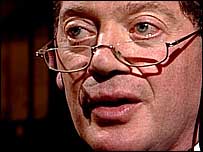 | | "To see a senior member of the profession behaving like
this undermines everything that a far greater number of solicitors do properly
and in the interests of justice." | | Tony Edwards
|
"In initial discussions with any potential client,
my first duty is to ensure that the instructions I am given are clear and that
the person understands what is happening to them. "The undercover reporter
was giving me mixed messages and his story did not fully make sense and, for that
reason, I explored every possible option and scenario with him. "I
fully accept that some of the remarks reported may have seemed inappropriate in
isolation."
"At all times during my time with the reporter
I was trying to assist someone who led me to believe they had come into my office
for help at a time of need. "I gained no benefit or fees from the
short time I spent with him, which was late in a very busy day in the hectic run-up
to Christmas." Criminal actions
At
the time of the original Inside Out filming, senior lawyers condemned Mr Lancaster's
behaviour as unethical.
Leading criminal lawyer Tony Edwards said:
"My
reaction to this tape is deeply depressing because there are solicitors up and
down the country doing a demanding job well and with courage. "He
was told the client had supplied drugs and yet he then went and did a substantial
interview to explain how each piece of evidence might be explained away. "He
said he should not be putting words into the mouth of the client but that is precisely
what he appears to do."
Judge Robert Pryor, QC, said:
"I'm shocked. I don't know this solicitor and he may be able to say something
about it which puts it in a completely different light.
"But on the
face of it, if this were a real case - and there's no reason to suppose the solicitor
thought it was anything else - it's a flagrant breach of the rules of professional
conduct and probably a criminal offence as well in that it involves perverting
the course of justice and attempting to pervert the course of justice.
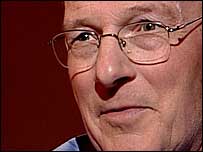 | | "If this is happening elsewhere, we have a really big
problem sorting it out." | | Sir Charles Pollard |
"Every day magistrates, judges and juries are trying to make up
their mind whether people are telling the truth or not and they are entitled to
assume that the witness who is giving his evidence, is giving his own evidence.
"He may have invented lies, but they are his own lies. If he is telling
lies and putting forward a story which is made more plausible by the perverted
use of the lawyer's knowledge and experience, then the job of the court becomes
very much more difficult, if not impossible."
Sir Charles Pollard,
former Chief Constable of Thames Valley Police, described Mr Lancaster's behaviour
as appalling. He said, "What is shown in this film is so serious that
I think judges, lawyers, the police, government ministers, policy makers - everyone
who has a role to play in the criminal justice system - needs to see this because
if this is happening elsewhere, we have a really big problem sorting it out." What
happened next?David Lancaster appeared in court and was sentenced
to three years imprisonment in October 2006 as a result of Inside Out's undercover
filming. Judge Cottle said: "It follows that if
any member of the legal profession engages in behaviour that brings the system
into disrepute, he threatens the deserved reputation of the criminal justice system,
and this necessarily has an impact on fellow professionals. "Your
behaviour in this case totally undermines that deserved reputation."
Web
links BBC
News - Solicitor jailed after BBC probe
BBC
Crime - The Law
Onelife:
Legal
Warner Goodman and
Streat
The Law Society
Thames Valley Police
Magistrates Association
The Law Commission The
BBC is not responsible for the content of external websites | 


 Inside
Out - South: Monday November 27, 2006
Inside
Out - South: Monday November 27, 2006