Warsaw-on-Sea
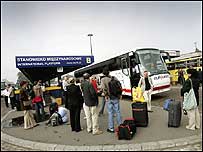 | | High hopes - Polish workers leave Warsaw for the UK. Getty
Images |
It's thought that one in 10 of the population of Southampton
is Polish, a figure often quoted by MP John Denham. Inside Out sets out
to challenge a few of the preconceptions being banded about about this new migrant
workforce. Six hundred thousand people have come from the eight accession
nations which joined the EU in May 2004
but those are the official figures.
So what's the real story? One idea Inside Out sets out to look at
is - are Eastern Europeans really doing jobs we don't want to do, or are they
taking jobs from Brits? The programme's road trip, with man-in-a-van Ashley
Blake, finds Eastern Europeans all over the country. Economic
boon Some economists estimate that migrant workers are worth
as much as half a billion to the economy and that they're actually propping it
up by getting jobs done here in industries which otherwise would go abroad. The
idea being, if we can't get our fruit and veg picked cheaply enough to make it
a competitive price when it goes to market, we'd end up importing it... probably
from Poland. The former Director General at the CBI, Sir Digby Jones, says
without this migrant workforce the country simply wouldn't function. Interest
rates would go up and wage inflation would price some British industries out of
the market. In Southampton nine coaches arrive every week from Poland,
dropping off a new workforce who've travelled for 36 hours across Europe to work
for the minimum wage, which for someone over 21 is £5.35 an hour.
Influx
of workers
| Poland Fact File | |
Location: Situated in the centre
of Europe.
Economy: High unemployment and generally
low incomes. Large huge farming sector. Poverty is widespread in rural areas.
EU status: Became an EU member in May 2004,
15 years after the end of communist rule.
Poland's
population is 38.5 million (UN, 2005).
The capital city is
Warsaw.
Main language - Polish.
Main religion
- Christianity.
Major exports are machinery, foodstuffs and chemicals.
Key phrases:
Tak - Yes
Nie - No
Witamy
- Welcome
Czesc - Hello
Listen
to the BBC audio guide to Polish |
The Polish workers
are happy to do the jobs that English workers don't want to do for a price that
many locals would find unacceptable. The minimum wage alone means the city's
streets are paved with gold. But some English workers resent the
newcomers from abroad, especially those working in the construction industry. Inside
Out meets Andy Kirby who set up his own building business three years ago. Until
recently he had 60 satisfied clients, and was a member of the Guild of Master
Craftsmen.
But Kirby says that he can't compete with Polish rates. His
fledgling company is about to fold under the competition: "I've
gone back and had a look at the figures
it's quite sickening. No one will
employ me - I'm too expensive." Plugging
the gaps
Many employers see the Eastern European migrant workers
as a way of filling jobs that others don't want to do in the south. Derek
and Lukas are currently working as caretakers - the school says that it looked
for workers but just couldn't get the staff.
Kevin Mills from the school
says that the migrant workers are a real asset: "We struggled
to find a caretaker
"They're very good and they're still here.
They are doing a great job." In Poland a teacher earns
£200 a month - these caretakers take home the same amount in just four days. It's
easy to understand the lure of Southampton for these Poles and the growing army
of eastern European migrants. Life in Reading And
Inside Out also takes a look at the old Polish community in Reading, and the impact
the recent influx of Polish immigrants has had on them.
Father Jerzy Januszkiewicz
says some of the older population, "are a little bit suspicious of the new
ones, and those that have just come say they are not welcome. "But
it's not true. We have to take time to know one another." The Polish
community in the town has gone from 1,000 to an estimated 10,000.
Have your
say...
Join the debate - email our Inside
Out England message board in English or Polish and we will publish your comments. Email
insideout@bbc.co.uk
We want your comments and experiences. How do old Poles feel about the new Poles?
What are the concerns and worries of old and new Poles?
And what's
happening to the economy and fellow workers back in Poland? How hard or
easy is it to find well paid jobs in the south of England? And if you're
a local worker, what are your views on the influx of foreign workers?
Links
relating to this story:The BBC is not responsible for the content
of external websites | 


 Inside
Out - South: Monday November 13, 2006
Inside
Out - South: Monday November 13, 2006