Tin
tabernacles 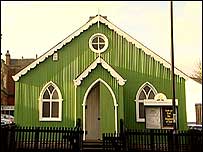 | | Tin
tabernacle - remarkable heritage building |
These days we're
always keen to save our historic buildings - and particularly churches. But
some of our most revolutionary places of worship are fast disappearing - and the
chances are you've probably never even noticed them.
Tin tabernacles
were a cheap alternative to churches, built by the Victorians to cope with swelling
congregations. We tend to think of the Victorians in terms of red-brick
and great grandiose structures, but in many ways these buildings are even more
extraordinary. Railway Mission
One example is the The Railway
Mission at Bury St Edmunds Station, opened in 1900.
At the time the
Mission was built the industrial revolution was sweeping through the country -
hundreds of thousands of people were on the move with more than half a million
people working on the railways alone.
It was built to provide a place
of worship for the railway workers. To begin with they met in a room on
the station platform - they had to raise they money to build this place. The
railway men approached a local lady, Mrs Arthur Ridley, about starting a railway
mission in the town. The churches were ordered as flatpacks - and there
were companies all over the country who'd provide the kit including Boulton and
Paul in Norwich. The tabernacle at Bury was put up by a contractor from
London and along with its furniture and fittings it cost £317 7s 7d - much
cheaper than building a brick church. Sadly many of the little tin churches
have disappeared. But there are still some that you can see. Other examples
can be seen on the Sandringham estate, Burgh Parva in Norfolk, Ipswich, Colchester,
Paglesham in Essex, and at the Museum of Rural Life at Stowmarket. Links
relating to this story:The BBC is not responsible
for the content of external websites | 


 Coming
Up : Inside Out - East: Monday February 13, 2006
Coming
Up : Inside Out - East: Monday February 13, 2006