
Nazi Propaganda
By Professor David Welch
Last updated 2011-02-17
Jews
By the late 1930s, the increasingly fanatical tone of Nazi propaganda reflected the growing radicalisation of the regime's anti-Semitic policies. The Jewish stereotypes shown in such propaganda served to reinforce anxieties about modern developments in political and economic life, without bothering to question the reality of the Jewish role in German society.
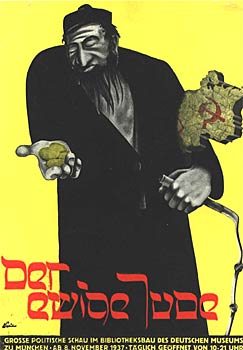
In November 1937 'The Eternal Jew' exhibition opened in Munich, and ran until 31 January 1938, claiming to show the 'typical outward features' of Jews and to demonstrate their allegedly Middle Eastern and Asiatic characteristics. The exhibition also attempted to 'expose' a world-wide 'Jewish-Bolshevik' conspiracy.
The striking poster for the exhibition contrasted Jewish individualism and 'self-seeking' with the Nazi ideal of a 'people's community'. It did this by revealing an 'eastern' Jew - wearing a kaftan, and holding gold coins in one hand and a whip in the other. Under his arm is a map of the world, with the imprint of the hammer and sickle.
The exhibition attracted 412,300 visitors, over 5,000 per day. The Secret Police reports claimed that it helped to promote a sharp rise in anti-Semitic feelings, and in some cases violence against the Jewish community.
World War One Centenary

- Find out more about how the BBC is covering the World War One Centenary, and see the latest programmes and online content
Surviving the trenches

Pack Up Your Troubles

BBC iD
BBC iDBBC navigation
BBC links

BBC © 2014 The BBC is not responsible for the content of external sites. Read more.
This page is best viewed in an up-to-date web browser with style sheets (CSS) enabled. While you will be able to view the content of this page in your current browser, you will not be able to get the full visual experience. Please consider upgrading your browser software or enabling style sheets (CSS) if you are able to do so.
