
Nazi Propaganda
By Professor David Welch
Last updated 2011-02-17
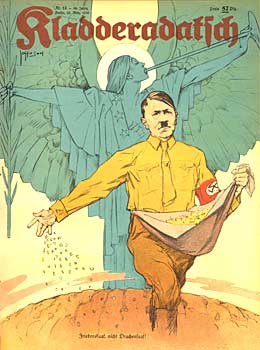
Sower of peace
Much of Hitler's popularity after coming to power rested on his achievements in foreign policy. A recurring theme in Nazi propaganda before 1939 was that Hitler was a man of peace, but one who was determined to recover German territories 'lost' as a result of the Versailles Treaty of 1919, drawn up at the end of World War One.
In 1936, when Germany re-occupied the Rhineland in contravention of Versailles, Hitler attempted to placate the Allies by speciously offering to conclude non-aggression treaties with France and Belgium, and to return Germany to the League of Nations.
The cartoon above is from the right-wing magazine Kladderadatsch. It dates from after Germany's illegal occupation of the Rhineland, but presents Hitler as a statesmanlike sower of peace. The figure of Peace is shown in the background, blowing a trumpet fanfare.
Since the mid-nineteenth century, the German periodic press had embraced a robust tradition of political satire. It is not surprising, therefore, that the Nazis seized upon the cartoon as an important propaganda vehicle.
World War One Centenary

- Find out more about how the BBC is covering the World War One Centenary, and see the latest programmes and online content
Surviving the trenches

Pack Up Your Troubles

BBC iD
BBC iDBBC navigation
BBC links

BBC © 2014 The BBC is not responsible for the content of external sites. Read more.
This page is best viewed in an up-to-date web browser with style sheets (CSS) enabled. While you will be able to view the content of this page in your current browser, you will not be able to get the full visual experience. Please consider upgrading your browser software or enabling style sheets (CSS) if you are able to do so.
