
Aerial Reconnaissance in World War Two Gallery
By Allan Williams
Last updated 2011-06-06
On this page
Page options
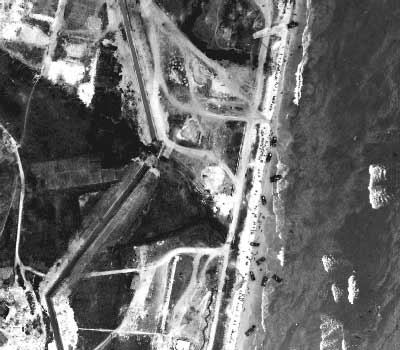
American troops landing on Omaha beach on D-Day
D-Day landings
The vast and complex job of planning for the Allies' D-Day landings depended heavily on aerial photography. Years before the final choice of beaches was made, photo interpreters had been watching the whole shoreline of northern France. They knew every gun emplacement, every pillbox, every wire entanglement and every trench system of the whole Atlantic Wall.
Their work paid off when, in June 1944, through a night of high winds and driving rain, a vast armada of over 6,000 ships, 50 miles wide and carrying 185,000 men and 20,000 vehicles, headed towards the beaches of northern France. It was the largest seaborne invasion in world history, and aerial photography played an absolutely crucial role in its eventual success. The photograph shows American troops landing on Omaha beach - scene of some of the bloodiest battles of the invasion.
World War One Centenary

- Find out more about how the BBC is covering the World War One Centenary, and see the latest programmes and online content
Surviving the trenches

Pack Up Your Troubles

BBC iD
BBC iDBBC navigation
BBC links

BBC © 2014 The BBC is not responsible for the content of external sites. Read more.
This page is best viewed in an up-to-date web browser with style sheets (CSS) enabled. While you will be able to view the content of this page in your current browser, you will not be able to get the full visual experience. Please consider upgrading your browser software or enabling style sheets (CSS) if you are able to do so.
