
Tank: Life and Times of a 'Wonder Weapon'
By Patrick Wright
Last updated 2011-02-17
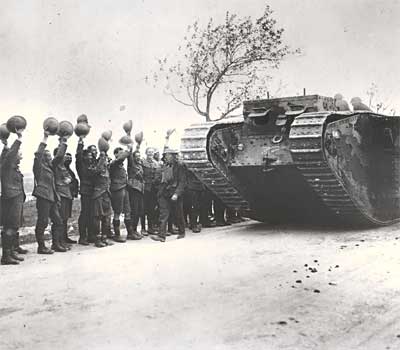
'Star turn' of the Western Front
'Star turn' of the Western Front
When tanks first appeared in France, they were considered comic. The first infantrymen who saw these theatrical machines as they made their way up to the Front, were inclined to burst into frantic laughter. Indeed, one infantryman was reported to have been shot in the throat as he stood up to roar at the sight of a tank advancing down a nearby road.
This laughter would become the subject of considerable speculation. No doubt the ‘mental explosion’ that greeted the tanks responded to the peculiar appearance of these machines, with their gradual, sometimes lurching motion and their eye-like sighting slits at the front.
The British ‘Mark I’ tanks did indeed resemble mechanical monsters – at once futuristic and prehistoric.
Yet those convulsions of laughter were also a tribute to what would come to be known as the ‘moral effect’ of the tank. They expressed both satisfaction at the terror the tanks would surely strike into the heart of the enemy, coupled with relief that these new war machines might, as their early champions indeed hoped, prove to be lifesavers for Allied infantrymen otherwise faced with charging into machine guns.
To begin with, the jocularity was shared by the men of the Tank Corps, or the Heavy Section as it was still known in 1916. They adopted the skull-and-crossbones as their emblem and coined absurd names to paint on the prows of their unlikely machines .
Yet those laughing onlookers quickly came to irritate the tank crews. They, after all, had to turn these primitive machines into effective weapons, and they had to do so with the benefit of only the most rudimentary training.
Confined in a cabin that was quickly turned into a ‘pocket Hell’ by heat, noise and fumes, to say nothing of enemy fire, they had only minimal visibility when under attack and were reliant on carrier pigeons for their communications.
While they soon tired of being laughed at, the tank soldiers also resented the expectation that they should spend their first weeks in France performing mechanical ballets, stunts and ‘star turns’ for audiences of VIPs and Allied officers - extra duties that consumed precious time perhaps better used to practise co-ordinating with infantry before going into battle.
Having endured the laughter, they soon enough had to endure the disenchantment that followed when the extravagant expectations brewed up around the new ‘wonder weapon’ were disappointed by their first faltering efforts.
World War One Centenary

- Find out more about how the BBC is covering the World War One Centenary, and see the latest programmes and online content
Surviving the trenches

Pack Up Your Troubles

BBC iD
BBC iDBBC navigation
BBC links

BBC © 2014 The BBC is not responsible for the content of external sites. Read more.
This page is best viewed in an up-to-date web browser with style sheets (CSS) enabled. While you will be able to view the content of this page in your current browser, you will not be able to get the full visual experience. Please consider upgrading your browser software or enabling style sheets (CSS) if you are able to do so.
