
WDYTYA? Series One: Celebrity Gallery
By Dan Waddell
Last updated 2011-02-17
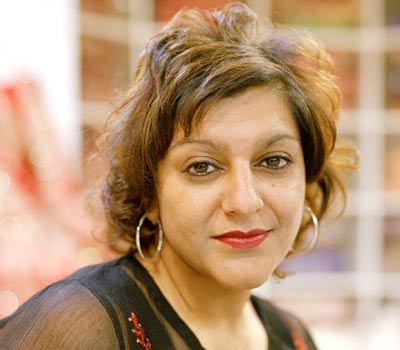
Meera Syal
- Rebel roots
- Meera Syal grew up in the mining village of Essington, in the West Midlands, a place she once famously described as "a cross between 'Twin Peaks' and 'Crossroads' ". Her work as a writer, in particular in her novel 'Anita and Me', successfully explores the contradictions inherent in growing up in modern Britain with immigrant Asian parents, and in living between two cultures. Despite the fact that cultural issues underpin Meera's work, until recently she had never taken an in-depth look into her family history, or searched for what she describes as her rebel roots.
Meera's parents both originate from the farmlands of the Punjab, in north-west India. Her father, Surendra Syal, hails from a small village called Lasara. In India it is difficult to trace your ancestry through documents like birth certificates, in the way that you can in the United Kingdom, but instead Indian family records are kept at shrines in the country's many holy cities. It is in the ancient city of Haridwar, on the riverbanks of the Ganges, that a Hindu priest is responsible for preserving the genealogy of the Syals, in a book called a Bah. It was in this book that Meera found that the Syals have been living in Lasara for the past 250 years.
- Struggle for independence
- Although the Syals originally came from Lasara, Surendra grew up in 1930s Lahore, where his father, Tek Chand Syal, had gone in search of better prospects. As a student at the DAV College in Lahore, Tek Chand became involved in the student demonstrations against the British. Some of these were peaceful protests but others were not, and he was forced to disappear temporarily from Lahore in the early 1930s. In 1936, however, he returned from hiding to begin his career as a journalist at Milap, an Urdu newspaper at the vanguard of the Indian independence movement.
The struggle for independence from the British was won in 1947, although the Partition of India was a severe price to pay for it. Punjab was carved in two, with one part of it in the separate state of Pakistan, and the other part in India, and so bore the brunt of the division. The Syals, like millions of other Partition refugees, were forced to flee from their home. Tek Chand decided that Lahore, in Pakistan, was not a safe place for his Hindu family, and he moved them to Delhi while he stayed behind.
For the next few months, Tek Chand was trapped in Pakistan and could not find anyone willing to take him across the border. Over in Delhi his family feared he was dead, yet another victim of Partition. Eventually a Muslim horse-and-cart driver agreed to make the perilous journey, and Tek Chand made it to India and rejoined his family. Unfortunately, the driver did not make it back to Pakistan. He was found dead, a victim of Hindu youths seeking revenge for the murder of one of their own.
- Protest marches
- Meera's mother's side of the family displayed rebel roots too. Her grandfather, Phuman Singh, marched with hundreds of other Sikhs during a struggle against the British in the village of Jaito in the Punjab. Phuman Singh participated in the 11th Jatha (a group of Sikhs), which set off from Amritsar in July 1924 and arrived in Jaito in early September 1924. Up to 20,000 Sikhs were arrested during these marches (the morcha), including Phuman Singh, who spent more than a year in prison. In 1972 he was awarded a Freedom Fighters Pension for his part in the Jaito Morcha.
Meera's parents met while studying at college in Delhi in the 1950s. They were from different religious backgrounds - Surendra was Hindu, Surinder was a Sikh - but nevertheless, they fell in love. Then for seven years they continued to meet, sometimes at the famous landmarks of Delhi, including India Gate and Lodhi Gardens.
When her parents suggested to their daughter that it was time to search for a suitable husband, Surinder confessed she had already found the man she wished to spend the rest of her life with. At first Phuman Singh objected to Surinder's choice of husband, on the basis of his religion, but in time he embraced his son-in-law. Very much in love, Surendra and Surinder married in Delhi in 1958.
In 1960, Surendra left India for England to pursue his education in London. His journey to England involved a 17-day boat trip from Bombay to Europe, followed by a train journey across Italy, Switzerland and France and then a ferry to Dover. Like other Asian immigrants at the time, he arrived at London's Victoria Station with only a minimum amount of money in his pocket. Little did he know that he would make a permanent home in the United Kingdom, and that some 40 years later his daughter would be researching his family's history for a television programme.
Family History
Programmes
BBC iD
BBC iDBBC navigation
BBC links

BBC © 2014 The BBC is not responsible for the content of external sites. Read more.
This page is best viewed in an up-to-date web browser with style sheets (CSS) enabled. While you will be able to view the content of this page in your current browser, you will not be able to get the full visual experience. Please consider upgrading your browser software or enabling style sheets (CSS) if you are able to do so.
