
Ancient Egyptian Gods Gallery
By Barbara Waterson
Last updated 2011-02-17
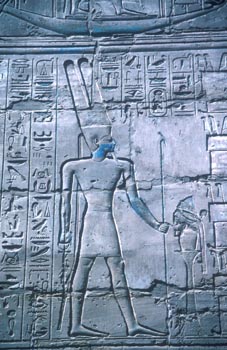
Amun
Amun, whose name means the Invisible One, was usually depicted as a man wearing two tall plumes on his head, and holding a sceptre in his hand. His sacred animals were the ram and the goose, both symbols of virility - which was one of Amun's characteristics.
During the Middle Kingdom he was identified with the god Re, as Amen-Re, and Thebes (modern-day Luxor) became his cult-centre. He rose to political importance as the favourite god of the kings who freed Egypt from Hyksos rule, and in the Eighteenth Dynasty royal patronage ensured that he outstripped all other gods in power and prestige.
His great temple at Karnak is a demonstration of his status as king of the gods.
Hands on History: Ancient Britain

Hands on History: Roman Britain
BBC iD
BBC iDBBC navigation
BBC links

BBC © 2014 The BBC is not responsible for the content of external sites. Read more.
This page is best viewed in an up-to-date web browser with style sheets (CSS) enabled. While you will be able to view the content of this page in your current browser, you will not be able to get the full visual experience. Please consider upgrading your browser software or enabling style sheets (CSS) if you are able to do so.
