
The 'Death in Sakkara' Gallery
By Dr Joann Fletcher
Last updated 2011-02-17
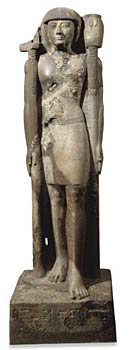
The Magician
- Khamwese, the Magician
- With inscriptions proclaiming his abilities throughout Sakkara and beyond, it is perhaps no surprise that Khamwese's name was known long after his death, albeit in a somewhat altered form. With his priestly title of sem, sometimes pronounced 'setem' and later 'setne', this gradually transformed to create the semi-mythical character 'Setne-Khaemwese'.
By the Ptolemaic Period a thousand years after his death, his reputation as a scholar had taken on epic proportions and as 'Setne-Khamwese' he had become a magician. The1% literate minority was long believed to possess special powers. Priests with access to ritual texts were often regarded as magicians, and with his own particular knowledge of literature stretching back to the beginning of Egypt's history, Khamwese would have been regarded as a very great magician indeed.
He even became the hero of a series of racy yarns, one of which opens with the prince contemplating hieroglyphs on a temple wall. Learning of the existence of the Book of Thoth, a magic text containing all the secrets of the universe, including how to resurrect the dead, Khamwese decided to find it. It was said to lie in the tomb of a long-dead magician, and after Khamwese locates the tomb, meets the magician's ghosts and engages in a long conversation, he takes the book for himself. The magician, wanting the book back, decides to punish him, and using the apparition of a beautiful priestess entices him to commit all manner of crimes to win her favours. As she disappears in a puff of smoke at the crucial moment, a naked Setne-Khamwese is left confused and humiliated, and realising resistance is futile, returns the book to the magician's tomb, his lesson learned. In a second story, his magical adventures continue when he visits the afterlife with his fictitious son Siosire and meets Osiris, Lord of the Underworld. After comparing the afterlife of the blessed with that of the damned, this moralistic tale ends with Siosire revealing his true identity as a magician from the past, reborn to rid Egypt of a malevolent Nubian sorcerer in a spectacular battle of magical wits.
Yet incredibly Khamwese's own reputation for magic continued into the 20th century and is based on his statue in the British Museum. This superb figure, measuring 1.46 metres and carved in an unusual conglomerate sandstone, shows Khamwese as high priest in the prime of life, striding forward with the standards of the gods. Believed to have been set up in the temple of Osiris at Abydos, the statue would have been created as a means for the living to give offerings to Khamwese's soul, although as recently as the 1930s, members of the Society of the Inner Light still regarded the figure to be 'oozing with magnetism' and a means by which they could contact unseen forces. As a result, Khamwese's statue, in the midst of the Egyptian sculpture gallery, became the focus of some unusual attention, and so seems the appropriate image with which to end the 'Death in Sakkara' game.
Hands on History: Ancient Britain

Hands on History: Roman Britain
BBC iD
BBC iDBBC navigation
BBC links

BBC © 2014 The BBC is not responsible for the content of external sites. Read more.
This page is best viewed in an up-to-date web browser with style sheets (CSS) enabled. While you will be able to view the content of this page in your current browser, you will not be able to get the full visual experience. Please consider upgrading your browser software or enabling style sheets (CSS) if you are able to do so.
