
The 'Death in Sakkara' Gallery
By Dr Joann Fletcher
Last updated 2011-02-17
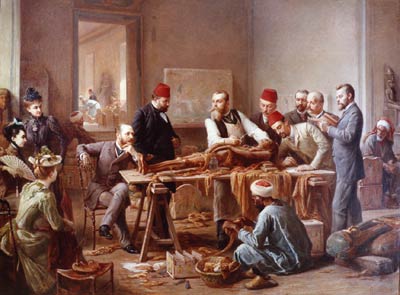
Egyptomania
- Egyptomania and the cult of the mummy
- Although the story of the 'Death in Sakkara' game is set in 1929, it is based on the 'Egyptomania' of the late 19th century. As Europe's fascination with ancient Egypt continued with the Victorians' desire to find archaeological proof for the Bible, the sensational discoveries of mass burials of the mummies of kings, queens and clergy between 1881 and 1898 led to ever greater interest. No trip down the Nile was complete without mummified remains to bring home as a souvenir. They were presented to foreign powers as diplomatic gifts by the Egyptian government, and mummies could still be purchased in the sale room of Cairo Museum in the early 20th century.
A feature in society drawing rooms and the subject of fashionable if somewhat voyeuristic 'unwrapping parties', mummies inevitably began to appear in horror fiction, beginning in 1892 with Arthur Conan Doyle's 'Lot No. 249', about a mummy bought at auction revived to kill the living. Following a spate of such tales, mummies in private homes were blamed for bringing all manner of misfortune to the families concerned, and those not destroyed or given 'Christian burials' were hastily donated to museums around the country.
Even empty coffins were felt capable of exerting a malign influence, with the famous medium Helena Petrovna Blavatsky advising one family to donate their coffin cover ('mummy board') to the British Museum after a series of untimely deaths were blamed on the vengeful spirit of the priestess it once covered. Her expression on the lid was described as 'a living soul in torment' by journalist W Stead, who asked the museum if he could hold a sèance 'to perform certain experiments with the object of removing the anguish and misery from the eyes of the coffin-lid'. The public were so taken with his story they even sent money for floral offerings, although the priestess appears to have retained her supposed powers and was blamed for sinking the Titanic in 1912, a disaster in which Stead himself died.
The mummies of Hull Museum - featured at the start of 'Death in Sakkara' - also tell an intriguing tale. One of their mummies, long thought to be a princess, had been acquired by a British diplomat in Egypt, and seems to have been part of the inspiration for Bram Stoker's 'The Jewel of Seven Stars'. This tale of an Egyptian queen reanimated by scholarly gentlemen was praised by Stoker's occult-minded friends such as the writer JW Brodie-Innes. The mummy itself was donated to Whitby Museum in 1903, the year the book was first published. In 1930 it was then sold to Hull museum's director Thomas Sheppard (the model for Dr Mortimer Armstrong in 'Death in Sakkara'), who soon acquired a second mummy from gifted polymath Edward Heron-Allen, an early member of the Society for Psychical Research. Both mummies formed the centrepiece of Hull's impressive Egyptian collection, and although 13 years later the museum was destroyed in wartime bombing together with all its records, both mummies survived as two more witnesses to Britain's long obsession with ancient Egypt's dead.
Hands on History: Ancient Britain

Hands on History: Roman Britain
BBC iD
BBC iDBBC navigation
BBC links

BBC © 2014 The BBC is not responsible for the content of external sites. Read more.
This page is best viewed in an up-to-date web browser with style sheets (CSS) enabled. While you will be able to view the content of this page in your current browser, you will not be able to get the full visual experience. Please consider upgrading your browser software or enabling style sheets (CSS) if you are able to do so.
