
Mesopotamia
By Dr Dominique Collon
Last updated 2011-07-01
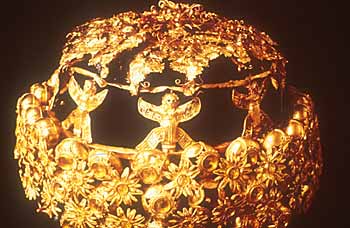
Assyrian crown
Ashur, on the Tigris, was the capital of the Assyrian state in northern Mesopotamia from about 2,500 BC. Under Ashurnasirpal II (883-859 BC) the capital was moved upstream to Kalah (now Nimrud). Here successive kings built a city, palaces and temples, which the British excavated in the 1840s and 1850s, and again in the 1950s.
Around 1990, Iraqi archaeologists found three very rich tombs, dating to about 750-700 BC, under the floors of rooms in Ashurnasirpal's harem. One contained this extraordinary gold crown: it has a trellis vine on top, with bunches of lapis-lazuli grapes hanging below it, supported by four-winged robed figures, standing on rows of pomegranates and rosettes.
When the Assyrian empire fell, in 612 BC, its great cities were comprehensively looted. This crown provides some evidence for the exquisite workmanship and vanished riches of the empire.
Hands on History: Ancient Britain

Hands on History: Roman Britain

BBC iD
BBC iDBBC navigation
BBC links

BBC © 2014 The BBC is not responsible for the content of external sites. Read more.
This page is best viewed in an up-to-date web browser with style sheets (CSS) enabled. While you will be able to view the content of this page in your current browser, you will not be able to get the full visual experience. Please consider upgrading your browser software or enabling style sheets (CSS) if you are able to do so.
