In content and in execution, Sam Mendes' Jarhead is intent on "confounding your expectations". Jake Gyllenhaal is the titular Marine sniper who is sent to war in Iraq and then doesn't get to shoot anyone. Based on the memoir by Anthony Swofford, this attempt to reinvent the war movie got better reviews in Europe than it did in the US, but still fell just short of recouping its $70m budget.
Shooting People
Mendes describes a series of Swoff's fantasies as "pivotal in the original screenplay and the book" in his commentary for four of these scenes. Among them Swoff imagines his drill instructor in a pink housedress and later blowing up his commanding officer while he's sitting "on the john". Joining Mendes for the track, veteran editor Walter Murch talks about hitting a surreal note in the way the sequences are cut together. For instance when Swofford imagines shooting the enemy, there is a feel of "time dilating" as he slips into the world inside his head.
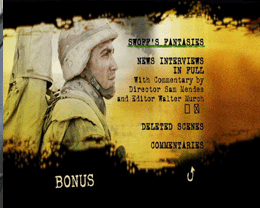
There are more creative insights in their commentary for 11 deleted scenes. Most notable is an alternative opening featuring Sam Rockwell as Swoff's uncle, imparting his wisdom to the young tyke in a straight-to-camera address. It's more than a little reminiscent of Christopher Walken's cameo in Pulp Fiction, only without the butt jokes. Another scene finds Swoff reading poetry as the squad sunbathes in the desert, but Mendes admits that, "This was badly staged by me". Apparently, it was the pressure of having to wrap the Mexican leg of the shoot.
Aim And Fire
The soldiers' testimonials (addressing a US TV news crew) were almost entirely improvised. A few excerpts appear in Swoff's Fantasies, but the full 16-and-a-half minutes of footage is presented separately. Again Murch and Mendes provide optional commentary, but Swoff's deep meditation on the subject of masturbation doesn't need too much explanation really... Watch out too for Evan Jones who is hilarious as the gung-ho dullard Fowler. When asked how he thinks the Kuwaiti people will respond to the US intervention, he says, "With a smile on their face, I guess... They wear those veils though, so you can't really see."
Mendes is unaccompanied for the main commentary, but he does give a comprehensive account of his intentions for the film and how he set about achieving those. He sums up the story best as a philosophical question: "What happens to the mind when it loses its focus?" He also points out where the film deviates from the book, eg the scene where Jamie Foxx (as Sgt Sykes) shoots a cadet during a training exercise wasn't in Swofford's account, but was based on a real story told to him by a marine who witnessed such an event.
Anthony Swofford speaks for himself in an alternative track with screenwriter William Broyles. Having served in Vietnam, Broyles saw more action than Swofford, but he could relate to the system of deprogramming that forms part of army training and which serves an integral part in this story. Recalling the first day of boot camp, he says, "You suddenly realise that everything you know is meaningless, especially your girlfriend." Swofford reflects how, as a sniper, all that energy becomes focused on "My Rifle". Calling Dr Freud!
Although there is no direct behind-the-scenes access and no interviews with the cast, the filmmakers afford a very detailed and interesting look at how they set about making a static story come to life on the big screen. It's worth clearing some headspace for.
EXTRA FEATURES