
When pathways to inclusion are open to people with disabilities it helps everyone.

“I often refer to disability as an illusion,” explained Former Senator Tom Harkin at the International Disability Summit that bears his name.
“They think that [disability] defines this person,” he told the delegates at ICC Belfast on 7 June 2022. “We know that a disability does not define a person – their dreams, aspirations… especially if the barriers are removed.”
In 1990, Harkin was one of the driving forces behind the Americans with Disabilities Act (ADA). As he opened the Belfast Summit, he recollected how he purposefully helped to draft the legislation to “ensure employment was number one”.
For Harkin, “work is a defining feature of human existence” (quoting the former Director-General of the International Labour Organization Juan Somavia). He wanted to convene influencers, policymakers from across the globe to “see how all of us together can come together and explore the best ways to advance the cause of inclusive, competitive, integrated employment”.
We, at the BBC, are proud that we could be part of the first Harkin Summit back in person following the coronavirus pandemic.
The panel, moderated by BBC Northern Ireland presenter Tara Mills, delved into how the media can impact societal change and the value given to disabled representation.
Director of BBC Northern Ireland Adam Smyth outlined how the BBC itself has changed since he joined the BBC almost 27 years ago.
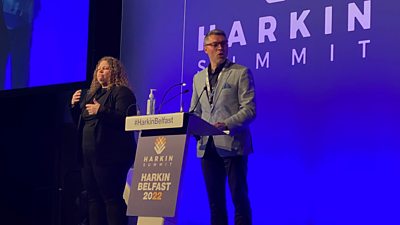
“I started in news, and the early 1990s marked the apotheosis of the US news networks. Their anchors and reporters were all tanned, good-looking, great hair, perfect teeth and, no doubt, perfect bodies,” Smyth regaled.
“Thankfully that mindset is also changing. Our shapes, sizes, perfections and imperfections are now far less important than they have ever been; what counts is much deeper – it’s our curiosity about the world, our eye for a story, our dogged determination to get to the bottom of something, and our acumen.”
He continued: “And, with disability in mind, what counts for us as a significant employer in UK broadcasting, is how we can remove the barriers to employment for those with talent who should not be denied access to the creative industries due to any impairment.”
And it is how the BBC is removing those barriers that the rest of the panel focussed on for the rest of the session.
Author and BBC disability ambassador Cerrie Burnell shared her story and how the BBC has come a long way in 15 years. One significant example she made was the creation of her role and more dedicated disability focussed members within the BBC Creative Diversity Unit – namely Kay Ashton and Nichola Garde.
Cerrie gave insight into talent pipeline initiatives, such as Elevate and also how they consult with content-makers to ensure they are reflecting disabled people to the best of their abilities.
“If you think about it something as subtle, or crucial, as language – getting language right or wrong can have a real impact on out audiences,” Burnell told the summit. “But we must also recognise that language is always changing.”
She gave her own personal example: “For instance, in a school and talked about my dyslexia as a hidden disability and it was only afterwards, I realised I told the students the wrong thing! It’s non-visible disability.”
Burnell did reassure the delegates saying they should not be afraid of getting it wrong because of the fact language is dynamic. It is an idea that underpinned the Inclusive Language Research commissioned by the BBC, BBC Studios and UKTV and conducted by IPSOS Mori.
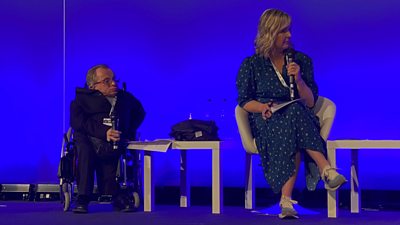
Allan MacKillop, the BBC’s Disability Team Leader for Content and Workforce Strategy, continued the share best practice with the Summit and focussed on the impact of the BBC Workplace Disability Passport which was implemented in 2019.
“It offers the employee the opportunity to document and write down how their health effects their work,” explained MacKillop. “It documents any adjustment they might need and moves with them as they change roles within the organisation.”
The passport is now being implemented by seven of the main UK broadcasters and is having impact beyond the media industry.
“The Department for Work and Pensions now see the passport as a valid way to support people and students,” MacKillop told delegates. “The next generation of disabled people will be fully versed in articulating their impairment.”
He continued: “The passport is about shifting the dial, but it doesn’t work well unless the organisation has initiatives to underpin what the passport does and shows is needed.”
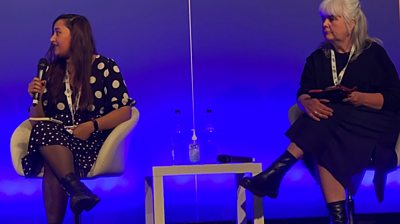
Sharmin Rahman, Reframing Disability Lead and 50:50 Project champion, told the Harkin Summit that it is crucial to ensure there is support when gaps are identified – whether that is in workforce or content.
For the latter, Rahman went on to explain how 50:50 The Equality Project has extended its data monitoring approach so content-makers can better understand how they are representing disabled people in the media.
She said that to content-makers need to be equipped if they are going to increase disabled representation, as data alone can only go so far.
“That’s where the Reframing Disability training comes in,” explained Rahman. “In the session we cover why underrepresentation of disabled people is important, we look at good and bad representation of examples, we understand how to diversify our spokespeople for the media and how to go about making reasonable adjustments.”
She added: “The success comes from making the training a safe space to help learners ask difficult questions”.
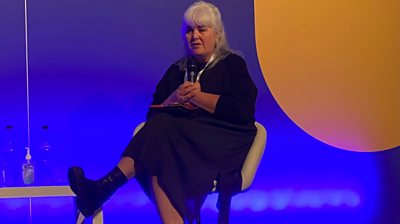
BBC Northern Ireland Commissioning Executive Fiona Keane reinforced the importance of supporting content-makers in their efforts to better reflect society.
“Commissioners like me now have a new tool kit – to help us measure and assess diversity from the point of commissioning – and tracking that right through to delivery and broadcast,” said Keane.
“We now have formal targets that are already having an impact both in front of and behind the camera. Targets that independent suppliers simply have to meet if they want the commission.”
She added: “Slowly, but surely, we are seeing change across the sector, and a growing awareness that diversity and inclusive story telling is not just a ‘public service broadcasting must have’ – but that it makes for brilliant programmes – moments of magic that connect with the audience in meaningful, and sometimes really beautiful and important ways.”
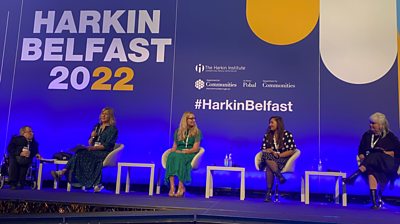
As the panel began to wrap up, Burnell came back on why increasing disabled talent is important. She said: “It’s about making content that moves people. And we’re working pan industry to ensure people can see themselves in what we do”.
“I remember getting scripts had a character down as ‘amputee’ that not their character, it is not what defines them,” said Burnell. “People are much more than their disability. Find out and get to know us.”
Burnell went on to tell delegates “we have great stories to tell and that’s why having deaf, disabled and neurodiverse creatives involved in content is so important” to enriching what is commissioned.
The final words, however, were left to MacKillop on what organisations need to do. “More direct pathways into the industry,” MacKillop simply said. “Things like the passport won’t work until there’s opportunities there in the first place.”