|
|
 |
The
census of the UK population was taken on 29th April 2001. On Thursday
13th February 2003, the Office of National Statistics released the
second phase of results.
Speaking on BBC Radio Cambridgeshire, Peter Goldblatt from the Office
of National Statistics explained how Cambridgeshire fared in comparison
to the rest of the country:
"The city of Cambridge is very different to the rest of the
region, especially as, for the first time, the census has allocated
students to their term-time address. This means that about one quarter
of Cambridge’s residents are students and as a result of this, nearly
half of the residents are single."
|
?? What was the population of the
United Kingdom on Census Day 2001 ?? |
| (Answer
at the bottom of the page) |
Transport
The student population also means that a very large percentage of
people travel to work on bicycles in Cambridge. Nearly one quarter
of those travelling to work choose this mode of transport. This
is not only a very different picture to other cities in the UK,
but also to other towns and cities in the rest of our county.
"Cambridgeshire has a very low percentage of people using public
transport," continues Mr Goldblatt. "Only 6% compared
to nearly 15% using public transport to get to work in England and
Wales as a whole. More people than average use their cars in the
county - 65% travel to work by car, but in Cambridge itself the
picture is slightly different with only 40% travelling to work by
car and only 8 or 9% using public transport."
|
?? What was the population of the
east of England on Census Day 2001 ?? |
| (Answer
at the bottom of the page) |
Population
On average there are about 2.4 people per household in Cambridgeshire
which reflects the national average. Across the country as a whole
there are now more single households and fewer married people. Once
again the picture is slightly different in Cambridge where there
is more student accommodation.
Ethnicity
Across the country, about 9% of people said their ethnic origin
was other than white, but that figure is somewhat different in the
east of England and in Cambridgeshire, where the figure is lower.
Religion
Across the country, nearly three quarters of people said they were
Christians. That percentage is similar in Cambridgeshire, although
an above average number of people in this county put themselves
down as having no religion - 18% compared to 15% in the country
as a whole. Cambridgeshire also has a smaller percentage of Muslims
than average.
Unpaid carers
For the first time ever, a question was included in the census about
whether people were providing unpaid care for friends or relatives.
Across the country, 5 million said they were providing some degree
of care. For 1 million of these, the amount of caring they provided
was close to a full-time job.
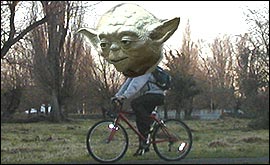
Jedi-ism
There is a burning question we all want the answer to, of course,
and that is, following the census, has "Jedi" become a
recognised religion? Mr Goldblatt explains: "There was a rumour
that if 10,000 people put themselves down as Jedi, then that would
become a recognised religion. Not so, but I can reveal that across
the country, 400,000 people put themselves down as "Jedi" when asked
about their religion."
This choice was particularly popular in towns with a large student
population, apparently. The Office of National Statistics decided
to classify all self-proclaimed Jedi followers as having "no religion".
Brainteasers:
The population of the United Kingdom on Census Day 2001 was 58,789,194.
Of these, the East of England accounted for approximately
5,000,000. |