

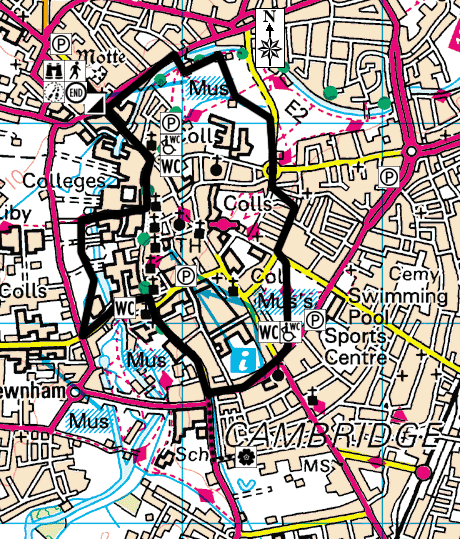
© Crown copyright. All rights reserved. BBC licence number 100019855, 2004.
Start Point: Castle Mound, near Shire Hall on Castle Street, Cambridge
City Ranger Helpdesk: 01223 458282
Ordnance Survey: Explorer
Distance: approx 2.5 miles
Time: approx 2.5 hours
Walk Conditions:
Most of the walk is along concrete or tarmac paths and pavements although there are opportunities to go off-road and explore on the grass which can become muddy after rain. Castle Hill is the only steep section of the walk.
 Start
the walk on top of Castle Mound on Castle Hill.
Start
the walk on top of Castle Mound on Castle Hill.
This is the highest point in Cambridge at more than 25m above sea level!
Many thousands of years ago, the top of Castle Hill was actually the bottom
of a river! There's a gravelly ridge running from Castle Hill along Huntingdon
Road, and deposits from this ridge date back from 200,000 years ago. This
provides evidence of a huge braided river that would have flowed in this
direction - a very ancient course of the river Cam.
Cambridge began on top of Castle Hill as a Roman garrison guarding the river crossing on the road to the north.
From
Castle Mound, walk down Castle Hill towards the junction with Chesterton
Lane.At the junction with Chesterton Lane, on the opposite side of the road you will see a tall pole which is a memorial to the Saxon graveyard found at this site four years ago.
From
the Saxon monument, walk along Chesterton Lane until you reach the bridge
that takes you over the river onto Jesus Green.
There's a deep channel which runs under Jesus College and Jesus Green,
up to the Cambridge City football ground and then up to the Histon Road
allotments. This 10-15 metre deep channel is another ancient course of
the river Cam.
The City football ground used to be called Swan's Pit and deposits have been found there that show that they were formed about 180,000 years ago, under the warm climatic conditions that existed between two cold phases of the Ice Age.
From
Jesus Green, walk along the tree-lined footpath until you reach the main
road (Victoria Avenue). Turn right and walk along the pavement - Jesus
College gardens are on your right and Midsummer Common is on your left.
Jesus College used to be a nunnery called St Radegund's. In the late 1400's
the Bishop of Ely - Bishop Alcock - turned it into a college, which is
why you can see black cockerels in various places throughout Jesus College
and on the coat of arms - it was Bishop Alcock's symbol.
Although Cambridge was founded way back in AD 70 the university didn't come to the city until the early 1200's.
From
Jesus College, head straight over the roundabout into Short Street, then
turn left into New Square - a small area of grass with rows of terraced
housing on three sides and the Grafton Centre off to the left.
Beneath the Grafton Centre and along Newmarket Road, there's another ridge
of gravel which indicates an ancient course of the Cam. Remains of reindeer,
arctic foxes and mammoths have been found on Newmarket Road which are
only about 20,000 years old and were formed during the last cold spell
of the Ice Age.
The area where the Grafton Centre now stands used to be the village of Barnwell, which, perhaps wrongly, had a bad reputation for prostitution! Until the late 1890's the university had the right to send young girls who may be a threat to the male students to a prison called the Spinning House.
Cross
diagonally over New Square and walk down Clarendon Street towards Parker's
Piece. At the end of Clarendon Street, turn left and walk up Parkside
until the pedestrian crossing where you should cross over to Parker's
Piece.
Parker's Piece is another very flat area. Like Coldham's Common, it is
under-laid by a large thickness of silt as it's an abandoned fossil flood
plain. During the mid 19th century there was a mining rush on Coldham's
Common as people dug for copralites which are black, phosphatic nodules.
Copralites were also found under Parkside Swimming Pool.
The rules for football were first conceived and used on Parker's Piece and soon after were adopted by the Football Association. They are still used today, with only slight modifications and refinements!
Walk
diagonally across Parker's Piece towards the Catholic Church. Continue
towards the main crossroads and cross straight over, and then over the
road again, so you are right outside the Catholic Church. Carry on walking
along Lensfield Road until you get to the junction with Trumpington Road
where you will see the Hobson's Conduit Fountain.
Hobson's Conduit was built in the early 1600's because there had been
a lot of plague in Cambridge. Both town and gown realised that they needed
to improve sanitation and provide a fresh water supply for the people
in the city centre. Spring water comes from Nine Wells in Shelford and
is then captured at Vicar's Brook and sent into town at various points
- above and below ground. You can see the conduit running along the side
of the road as you walk along Trumpington Street.
The conduit head (fountain) used to stand in the Market Square but was moved to Trumpington Road after a fire in the 1850's.
Keep
walking down Trumpington Street, past the Fitzwilliam Museum, then follow
the road round to the left which turns into Silver Street. Walk over Silver
Street bridge, where you will see the famous Mathematical Bridge on your
right. Keep walking past Queen's College til you reach a grassy area called
Queen's Green.
Standing on Queen's Green, you can look up along Silver Street, across the traffic lights and up towards Sidgwick Avenue. Sidgwick Avenue is a flat terrace that runs across this part of West Cambridge. It's another ancient course of the river Cam.
In an excavation near the law faculty on Sidgwick Avenue they found plant remains and a huge bison skull which you can see the skull on display at the Sidgwick Museum.
Keep
walking along the path on Queen's Green. You're now walking on the Backs
- the historic grassy area behind King's College. Walk along the path
until you get a good view of King's College and the magnificent chapel.
King's College is actually built on rubbish! Medieval waste was dumped off into the river and below the college you'll find hundreds of years of rubbish.
Looking at King's College is a reminder that the university makes Cambridge unique in that it provides magnificent architecture and landscaping right in the centre of town!
Keep
following the path along the Backs until you reach Garret Hostel Bridge.The course of the river Cam that you see today as you stand on Garret Hostel Bridge was formed about 10,000 years ago and has hardly moved from that course since!
Go
over the bridge and turn left once you reach Trinity Lane. Keep walking
along Trinity Lane until you reach Trinity Street - where you will see
a row of shops. Turn left and walk along Trinity Street and St John's
Street.
As you walk past the entrances of Trinity and St John's Colleges, it is
another chance to admire the grand architecture.
Look carefully at the entrance to Trinity College and the statue of Henry VIII.. can you see what's wrong with it? You can also see an apple tree outside Trinity College which is allegedly grown from the seed from the apple tree that Newton sat under!
See if you can spot the fox disappearing into a hole with a goose or swan on the crest above the gates of St John's College.
Turn
left at the end of St John's Street at the Round Church and walk up Bridge
Street towards the Quayside.
The bridge at Quayside was known as the Great Bridge and it was the main
bridge in and out of Cambridge.
For centuries Market Square was the centre of town, but suddenly in 1845, the railway arrived and the river was used less and less as a means of transport and communication.
Cambridge continues to move and grow - how will it develop in the future?
