| 28 October 2014 |

|
|
| BBC Homepage | | |
| |||
| Contact Us | | |
FeaturesYou are in: Bristol > Faith > Features > One of the best examples of medieval architecture in the country 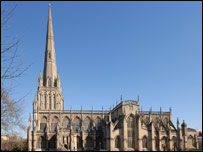 One of the best examples of medieval architecture in the countryOn a visit to Bristol in 1574 Queen Elizabeth 1 is said to have described it as "the fairest, goodliest and most famous parish church in England." St Mary RedcliffeCecile Gillard from St Mary Redcliffe talks to our reporter Jo Dwyer Help playing audio/video The grandeur of the church has been admired through the ages. The scale and beauty of the building gives the impression that it was intended to be a cathedral, yet it's purpose has always been that of a parish church, to serve as a gathering place for the Christian community to worship God. See more pictures of the churchChristians have worshipped continuously on the site occupied by St Mary Redcliffe for nearly 900 years. 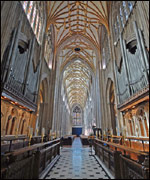 From the nave to the west end The first church here was built in the early 12th century. The oldest parts of the present building date back to 1185, although most of the nave, transepts and choir was created by highly skilled yet unrecorded stonemasons in the 14th century. The building's floor plan is the traditional cruciform shape, symbolic of the cross used for crucifixion. It is very much a city centre church, occupying the middle of a roundabout near Temple Meads Railway Station, with major roads like Redcliffe Way and Redcliffe Hill surrounding it. The church stands like an oasis of calm amongst the busy traffic of Bristol. It's physical location is fundamental to the historic maritime and mercantile importance of Bristol. 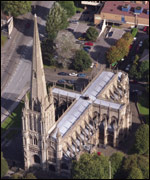 An aerial view To the north of the church lies the line of the medieval Portwall, to the west the quayside and harbour, plus the red coloured sandstone cliffs from which the area gets it's name. Being sited on the red cliffs above the floating harbour, the church was originally at the very centre of shipping and industry which is the key to its history. The merchants of the port of Bristol began and ended their voyages at the shrine of Our Lady of Redcliffe. It is to these merchants, especially to William Canynges and his grandson in the 14th and 15th centuries, that we owe the body of the church as we see it today. William Canynges the younger (1399-1474) was a Redcliffe merchant, who became an MP, was five times Mayor of Bristol and eventually took holy orders as a priest. 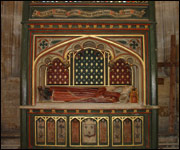 Tomb of William Canynges He was one of several generous merchant benefactors whose gifts enabled the present impressive church to be built. To this day, the friends' organisation for the church bears his name - the Canynges Society. The building has many merchant marks, medieval corporate logos, identifying other benefactors. John Cabot, who sailed from Bristol in his ship the Matthew, to discover Newfoundland in 1497, is also commemorated in the church. On his return, Cabot gave thanks for his voyage by presenting a whale bone to St Mary Redcliffe. Five hundred years later, the crew of the second Matthew, a replica of the first, gathered in the north porch of the church to pray for a safe journey before embarking on the same route across the Atlantic as Cabot. 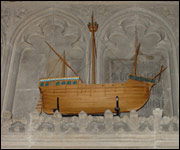 Replica of the new Matthew Earlier, at a service of dedication and blessing, they presented the church with a model of the ship, which now rests above the north porch door. By the 18th century the effects of the Civil War and the lack of money for repairs had taken their toll on the building. Queen Anne, disturbed by the condition of the Church of England, gave some of her wealth for the upkeep of the churches. St Mary Redcliffe received some of this money. This enabled the congregation to decorate the interior of the building in the flamboyant Baroque style. A great painting was commissioned, along with wrought iron gates. The finest organ builders of the time, Harris and Byfield, were employed to replace the organ lost in the Civil War. The church, filled with marble, with whitewashed walls, became a far cry from the gloom of the once Gothic interior. The church is known for it's beautiful stained glass windows, some of which still contain stained glass from medieval times. By the 18th century there was little stained glass left in the church and it was not until the restoration programme of 1842 started that stained glass windows appeared in the church again. 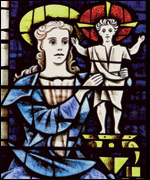 Stained glass window in the Lady Chapel In 1915 the last of the windows on the ground level was filled with stained glass. The windows in the Lady Chapel are relatively new, having been designed and crafted in the 1960s. Another relatively new aquisition, is the organ, built in 1912 by the famous firm of Harrison and Harrison. It is widely regarded as an instrument of tremendous importance and the church is in the process of restoring it. The St Mary Redcliffe Organ Appeal needs to raise £800,000. During World War 2 the church found itself on a flight path between Avonmouth and Bristol Docks, Temple Meads Station and the aircraft and aero-engine factories of north Bristol. 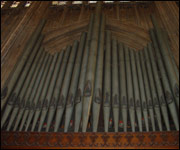 The organ A team of volunteer firewatchers supplemented official efforts to safeguard the whole area, including the church. When incendiary bombs rained down on the church's roof, young men as young as 16 used buckets of sand or earth to try to contain the damage. Teams of the firewatchers stayed at the church overnight on 12 hour shifts. The church has been in a constant state of restoration through the ages as can be seen in the pastiche of different styles. The local Christian community built this beautiful church and each generation has adapted the building to create what we see now. That's a source of great pride to those who use the church as a place of worship today. last updated: 27/06/2008 at 12:28 You are in: Bristol > Faith > Features > One of the best examples of medieval architecture in the country
Podcast[an error occurred while processing this directive] |
| | About the BBC | Help | Terms of Use | Privacy & Cookies Policy |